François-Antoine-Édouard Keller
 Librería Samer Atenea
 Kálamo Books
 Librería Elías (Asturias)
 Librería Kolima (Madrid)
 Librería Proteo (Málaga)
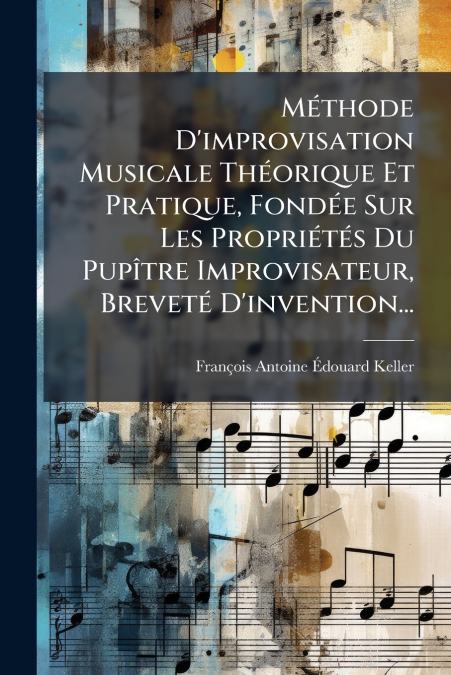
Méthode D’improvisation Musicale Théorique Et Pratique, Fondée Sur Les Propriétés Du Pupître Improvisateur, Breveté D’invention... par François-Antoine-Édouard Keller, est un traité détaillé sur l’improvisation musicale. Ce livre, rédigé en français, explore les fondements théoriques et pratiques de l’improvisation, en se basant sur les caractéristiques spécifiques d’un pupitre d’improvisation breveté. L’ouvrage offre une approche unique de l’apprentissage de l’improvisation, combinant des principes théoriques avec des exercices pratiques. Il s’adresse aux musiciens souhaitant développer leurs compétences en improvisation et à ceux qui s’intéressent à l’histoire de la pédagogie musicale. Cette méthode, ancrée dans le contexte musical du XIXe siècle, représente une ressource précieuse pour comprendre les techniques d’improvisation de cette époque.This work has been selected by scholars as being culturally important, and is part of the knowledge base of civilization as we know it. This work was reproduced from the original artifact, and remains as true to the original work as possible. Therefore, you will see the original copyright references, library stamps (as most of these works have been housed in our most important libraries around the world), and other notations in the work.This work is in the public domain in the United States of America, and possibly other nations. Within the United States, you may freely copy and distribute this work, as no entity (individual or corporate) has a copyright on the body of the work.As a reproduction of a historical artifact, this work may contain missing or blurred pages, poor pictures, errant marks, etc. Scholars believe, and we concur, that this work is important enough to be preserved, reproduced, and made generally available to the public. We appreciate your support of the preservation process, and thank you for being an important part of keeping this knowledge alive and relevant.