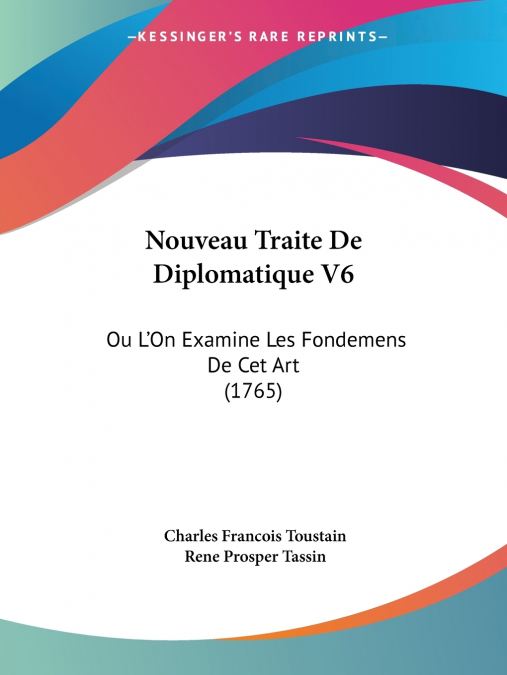
Charles François Toustain / René Prosper Tassin
 Librería Samer Atenea
 Kálamo Books
 Librería Elías (Asturias)
 Librería Kolima (Madrid)
 Librería Proteo (Málaga)
Methode De Diplomatique, Ou L’on Traite Des Caracteres Des Differens Actes Anciens, Des Titres & Des Chroniques, Des Regles A Observer Dans Le Jugement De Ces Actes, & De La Maniere D’en Dresser De Nouveaux is a comprehensive treatise on diplomacy and historical documents. Authored by Charles François Toustain and René Prosper Tassin, this work delves into the characteristics of ancient acts, titles, and chronicles. It provides rules for evaluating these documents and offers guidance on drafting new ones.Written in French, this book is an invaluable resource for historians, legal scholars, and anyone interested in understanding the intricacies of historical record-keeping and diplomatic practices in France. This meticulous examination ensures its enduring relevance for those studying the evolution of legal and historical documentation.This work has been selected by scholars as being culturally important, and is part of the knowledge base of civilization as we know it. This work was reproduced from the original artifact, and remains as true to the original work as possible. Therefore, you will see the original copyright references, library stamps (as most of these works have been housed in our most important libraries around the world), and other notations in the work.This work is in the public domain in the United States of America, and possibly other nations. Within the United States, you may freely copy and distribute this work, as no entity (individual or corporate) has a copyright on the body of the work.As a reproduction of a historical artifact, this work may contain missing or blurred pages, poor pictures, errant marks, etc. Scholars believe, and we concur, that this work is important enough to be preserved, reproduced, and made generally available to the public. We appreciate your support of the preservation process, and thank you for being an important part of keeping this knowledge alive and relevant.
![Court-Hand Restored [1879]]( https://distri.podiprint.com/imagenes/978/1/6/1/6/1/9/6/9781616196899_f_675x675.jpg "Court-Hand Restored [1879]")
![Commentary to the Germanic Laws and Mediaeval Documents [1915]]( https://distri.podiprint.com/imagenes/978/1/5/8/4/7/7/0/9781584770053_f_675x675.jpg "Commentary to the Germanic Laws and Mediaeval Documents [1915]")