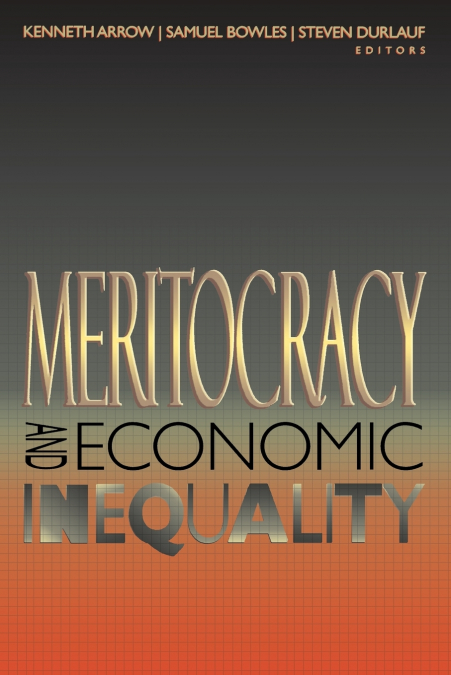

Meritocracy and Economic Inequality

Meritocracy and Economic Inequality

Meritocracy and Economic Inequality


114,75 €
IVA incluido
Disponible
Editorial:
Princeton University Press
Año de edición:
2000
Materia
Macroeconomía
ISBN:
9780691004686
114,75 €
IVA incluido
Disponible

Selecciona una librería:

  • Librería Samer Atenea
  • Librería Aciertas (Toledo)
  • Kálamo Books
  • Librería Perelló (Valencia)
  • Librería Elías (Asturias)
  • Donde los libros
  • Librería Kolima (Madrid)
  • Librería Proteo (Málaga)

Most Americans strongly favor equality of opportunity if not outcome, but many are weary of poverty’s seeming immunity to public policy. This helps to explain the recent attention paid to cultural and genetic explanations of persistent poverty, including claims that economic inequality is a function of intellectual ability, as well as more subtle depictions of the United States as a meritocracy where barriers to achievement are personal--either voluntary or inherited--rather than systemic. This volume of original essays by luminaries in the economic, social, and biological sciences, however, confirms mounting evidence that the connection between intelligence and inequality is surprisingly weak and demonstrates that targeted educational and economic reforms can reduce the income gap and improve the country’s aggregate productivity and economic well-being. It also offers a novel agenda of equal access to valuable associations. Amartya Sen, John Roemer, Robert M. Hauser, Glenn Loury, Orley Ashenfelter, and others sift and analyze the latest arguments and quantitative findings on equality in order to explain how merit is and should be defined, how economic rewards are distributed, and how patterns of economic success persist across generations. Moving well beyond exploration, they draw specific conclusions that are bold yet empirically grounded, finding that schooling improves occupational success in ways unrelated to cognitive ability, that IQ is not a strong independent predictor of economic success, and that people’s associations--their neighborhoods, working groups, and other social ties--significantly explain many of the poverty traps we observe. The optimistic message of this beautifully edited book is that important violations of equality of opportunity do exist but can be attenuated by policies that will serve the general economy. Policy makers will read with interest concrete suggestions for crafting economically beneficial anti-discrimination measures, enhancing educational and associational opportunity, and centering economic reforms in community-based institutions. Here is an example of some of our most brilliant social thinkers using the most advanced techniques that their disciplines have to offer to tackle an issue of great social importance.
Artículos relacionados

  • Introduction to Dynamic Macroeconomic General Equilibrium Models
    José Luis Torres Chacon
    This book offers an introductory step-by-step course in Dynamic Stochastic General Equilibrium modelling. Modern macroeconomic analysis is increasingly concerned with the construction, calibration and/or estimation and simulation of Dynamic General Equilibrium (DGE) models. The book is intended for graduate students as an introductory course to DGE modelling and for those econo...
    Disponible

    61,40 €

  • International Education and the Next-Generation Workforce
    Wei Wang
    Education is the first stage in developing a viable, dynamic, and long-lived global economy. Unfortunately, in times of economic hardship, educational programs, teacher salaries, and extracurricular opportunities are often the first to be cut. International Education and the Next-Generation Workforce: Competition in the Global Economy presents a detailed discussion of present e...
  • Macroeconomic Policies of Developed Democracies
    Robert J Franzese Jr
    ...
  • End Of The Road
    Louis Holder
    This book is about the mismanagement of Western economies in pursuit of political power, which resulting devastation will have to be borne by future generations. The book establishes that postponement is no longer doable and lays out the hard choices ahead causing much misery and agony.Although not fully recognized because of masking by asset bubbles, which are spun/sold as in...
    Disponible

    16,42 €

  • The Darwin Economy
    Robert H. Frank
    What Charles Darwin can teach us about building a fairer societyWho was the greater economist-Adam Smith or Charles Darwin? The question seems absurd. Darwin, after all, was a naturalist, not an economist. But Robert Frank, New York Times economics columnist and best-selling author of The Economic Naturalist, predicts that within the next century Darwin will unseat Smith as the...
    Disponible

    22,42 €

  • Myth and Measurement
    Alan B. Krueger / David Card
    From David Card, winner of the Nobel Prize in Economics, and Alan Krueger, a provocative challenge to conventional wisdom about the minimum wageDavid Card and Alan B. Krueger have already made national news with their pathbreaking research on the minimum wage. Here they present a powerful new challenge to the conventional view that higher minimum wages reduce jobs for low-wage ...
    Disponible

    39,64 €