
Mercedes-Benz

Mercedes-Benz

Etienne Psaila

21,40 €
IVA incluido
Consulta disponibilidad
Editorial:
Independently Published
Año de edición:
2026
Materia
Historia de empresas específicas/historia societaria
ISBN:
9798901940310

Selecciona una librería:

  • Librería Samer Atenea
  • Librería Aciertas (Toledo)
  • Kálamo Books
  • Librería Perelló (Valencia)
  • Librería Elías (Asturias)
  • Donde los libros
  • Librería Kolima (Madrid)
  • Librería Proteo (Málaga)

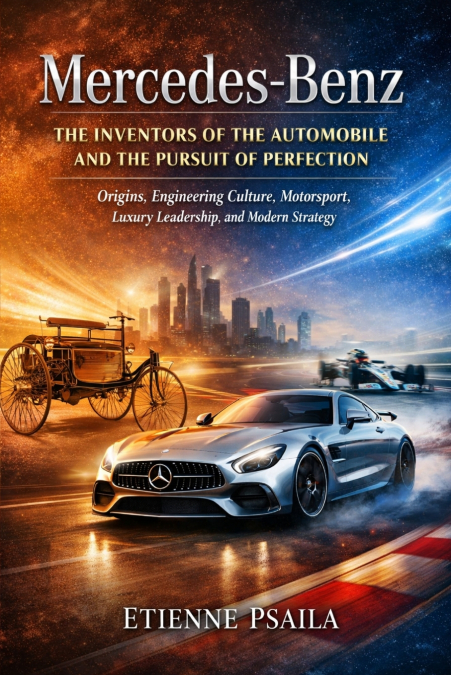
Mercedes-Benz is not simply one of the world’s great luxury marques; it is woven into the origin story of the automobile itself. From the industrial workshops of late-19th-century Germany to the global premium market of the software-and-electrification era, the company’s history is a continuous argument about what 'the best' should mean-and how hard it is to keep that definition intact as technology, politics, regulation, and customer expectations evolve.This book follows Mercedes-Benz across the full span of its modern identity: the parallel breakthroughs of Benz and Daimler-Maybach, the creation of 'Mercedes' as a name and a promise, the pressures of war and recovery, and the 1926 merger that fused two engineering lineages into a single corporate language of proof. It shows how manufacturing discipline, export strategy, and brand hierarchy were built-not as slogans, but as systems-while motorsport alternated between laboratory and theatre, turning technical performance into public mythology.In the modern era, the narrative tightens around the central tension that defines Mercedes-Benz today: maintaining luxury leadership while rewriting the car’s fundamentals. Electrification, emissions compliance, safety governance, and software-defined architectures have changed what the product is and how it must be made, validated, updated, and sold. Mercedes-Benz’s response-value-over-volume positioning, platform reinvention, and a reassertion of 'top-end' identity-reveals a company still chasing perfection, but now doing so in a world where the rules of excellence never stay still.
Artículos relacionados

  • The Rise and Fall of H&H Bagels
    Marc Zirogiannis
    In September, 2015 President Barack Obama informed The Forward, in a historic interview, of his shock at learning of the closing of his favorite NYC Bagel eatery, H&H Bagels, in January of 2012. While the President was shocked by the closing of the world’s most famous, and recognizable, bagel brand, what was truly shocking were the underlying facts and circumstances surrounding...
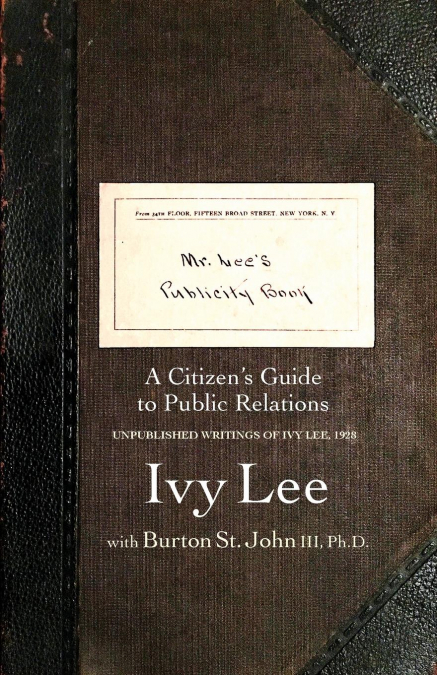
  • Mr. Lee’s Publicity Book
    Ivy Ledbetter Lee
    This book, newly discovered from the archives of his biographer, is Ivy Lee’s only known full-length manuscript. Written in the mid-1920s, a time when the public relations field was first coming into its own, it is a guide not as much for the practitioner, but wisely, for a Jazz-Age public facing its first-ever bout of “information overload.” Lee advises the reader how to ident...
    Disponible

    47,29 €

  • Selling Creative - Advertising Men and Women in the Hall of Fame
    Mary E. Warlick
    Americans have long enjoyed a fascination with advertising, a complex love-hate relationship. Ads are often connected with childhood recollections of favorite brands and characters-whether they are annoying, entertaining or persuasive, and the messages often lodge in our memories long after the actual product has disappeared from our consciousness. 'Melts in Your Mouth, Not in ...
    Disponible

    42,35 €

  • Global Electrification
    Mira Wilkins / Peter Hertner / William J. Hausman / William JHausman
    ...
    Disponible

    70,50 €

  • Verse by the Side of the Road
    Frank Rowsome
    ...
    Disponible

    26,51 €

  • Corporate Control, Corporate Power
    Edward S. Herman / Edward SHerman
    ...
    Disponible

    63,37 €

Otros libros del autor

  • Geely
    Etienne Psaila
    Geely’s rise is one of the defining industrial stories of the 21st-century car business-not because it followed the familiar path of a single brand climbing the ladder, but because it built modern automotive power the way the industry increasingly works: through platforms, capital, partnerships, and governance. From its beginnings in China’s reform-era private economy to its em...
  • BYD
    Etienne Psaila
    A battery company becoming a major automaker isn’t a catchy headline-it’s a blueprint for how the global car business is being rebuilt around electrification, supply security, and manufacturing scale. BYD’s rise tracks an industrial transformation that began in Shenzhen’s fast-moving, export-facing manufacturing economy and grew into one of the defining automotive stories of th...
  • SAIC
    Etienne Psaila
    SAIC’s ascent is one of the defining industrial stories of modern China: a Shanghai-based state enterprise that learned to build at world scale by combining policy mandate, foreign partnership, and an unforgiving culture of mass production. This book follows that trajectory from the city’s early workshops and planned-economy production routines through the reform-era opening th...
  • Lancia
    Etienne Psaila
    Lancia’s story is one of engineering audacity meeting industrial constraint. From Turin in 1906, the company built a reputation for doing things the difficult way on purpose-pioneering structural ideas, refining ride and handling when most rivals still chased simple durability, and repeatedly treating innovation as a core identity rather than a marketing layer.That same identit...
  • McLaren Automotive
    Etienne Psaila
    McLaren Automotive didn’t inherit a century of road-car tradition-it built a modern supercar business almost from first principles, using racing discipline as its operating system and carbon fibre as its defining architecture. From the MP4-12C onward, McLaren set out to prove that extreme performance could be engineered into a repeatable, warrantied, global product: light, stif...
  • Lotus
    Etienne Psaila
    Lotus has always been more than a marque; it’s been a methodology. Built in a Britain that prized ingenuity over abundance, the company turned constraint into an advantage-treating mass as the enemy, structure as an art, and steering feel as a non-negotiable. From the earliest 'specials' and kit-car pragmatism through the defining road cars that taught the industry what handlin...