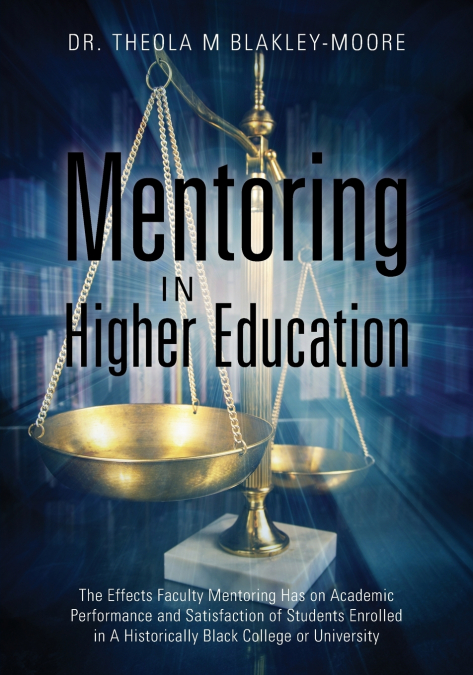
Mentoring in Higher Education

Mentoring in Higher Education

Mentoring in Higher Education

Dr. Theola M. Blakley-Moore / DrTheola MBlakley-Moore

27,64 €
IVA incluido
Disponible
Editorial:
Outskirts Press
Año de edición:
2015
ISBN:
9781478746461
27,64 €
IVA incluido
Disponible

Selecciona una librería:

  • Librería Samer Atenea
  • Librería Aciertas (Toledo)
  • Kálamo Books
  • Librería Perelló (Valencia)
  • Librería Elías (Asturias)
  • Donde los libros
  • Librería Kolima (Madrid)
  • Librería Proteo (Málaga)

The purpose of this mixed methodological study was to examine if faculty to student interaction through formalized mentoring, can be associated with the positive outcomes of academic performance and the college experience, as it relates to graduation and retention rates in a Historically Black College and University within the United States. The study provided information that may contribute to the improvement of the graduation rates of students seeking an undergraduate degree in a HBCU. Formalized mentoring can be tailored to be more personal than professional in becoming actively involved with students, who are experiencing the psychosocial risk factors, in motivating and engaging them during college enrollment (Heisserer, 2002). The underlying relationship between academic performance, graduation rate, and a student’s college experience, was tested during the course of this research. The aspects of mentoring can build upon friendship, self-esteem, confidence, and acceptance among others, in overcoming academic failure (Zagenczyk et al., 2009). There is a great need for nurturing of students attending a Historically Black College and University, in promoting successful outcomes and in improving the graduate rates on a national level. The results of this study will provide administrators with important answers on how a formalized mentoring program, can contribute to successful academic performance and student satisfaction for students attending a HBCU. Mentoring can also influence matriculation, academic achievement and completion of course in earning a college degree. The Education Commission of the States (2004) focus on the goal of retaining students upon entry into an institution, while helping them to complete their undergraduate requirement within four to six years. Students, who feel pressure of psychosocial risk factors, must be persistent in fitting into the college environment, through the development of social interaction, self-confidence and eng
Artículos relacionados

  • Pragmatic Meditations on Learning Community Pedagogy
    Andrew J Weigert
    This groundbreaking book convincingly explains why a Learning Community Pedagogy (LCP) is a critical supplement to traditional teacher-student relation­ships. Based on a participatory democratic learning dynamic, LCP empowers both professor and student to discover themselves as present to one another, which generates freedom—an informing principle of the Learning Community.Thro...
    Disponible

    20,49 €

  • Global Challenges and Perspectives in Blended and Distance Learning
    Even in higher education, the traditional perception of learning is a face to face environment; while distance education is typically thought of as its alternative. However, the continuous expansion of technology has altered this point of view as a more flexible option of education, not an alternative. Global Challenges and Perspectives in Blended and Distance Learning highligh...
  • Open Learning and Formal Credentialing in Higher Education
    Amy Antonio / Mike Keppell / Shirley Reushle
    The discipline of education is a multi-faceted system that must constantly integrate new strategies and procedures to ensure successful learning experiences. Enhancements in education provide learners with greater opportunities for growth and advancement. Open Learning and Formal Credentialing in Higher Education: Curriculum Models and Institutional Policies is an authoritative...
  • Handbook of Research on Global Issues in Next-Generation Teacher Education
    There is no question that all aspects of modern life have been imbued with technology. In education, students are becoming increasingly savvy in their use of the myriad technologies and virtual tools and must be taught adequate complimentary skills to be effective in the 21st century workforce. To answer this call, teachers’ education must reflect modern demands by integrating ...
  • Creating a New Public University and Reviving Democracy
    Davydd J Greenwood / Morten Levin
    Public universities are in crisis, waning in their role as central institutions within democratic societies. Denunciations are abundant, but analyses of the causes and proposals to re-create public universities are not. Based on extensive experience with Action Research-based organizational change in universities and private sector organizations, Levin and Greenwood analyze the...
    Disponible

    38,08 €

  • Education, Migration, and Cultural Capital in the Chinese Diaspora
    Johanna Waters
    provides an important and timely contribution to an emergent body of work, reflecting increasing interest in the internationalisation of education and the transnational mobility of students worldwide. The last two decades have seen the dramatic expansion and consolidation of what has astutely been called an ’international education industry’, involving the increased marketisati...