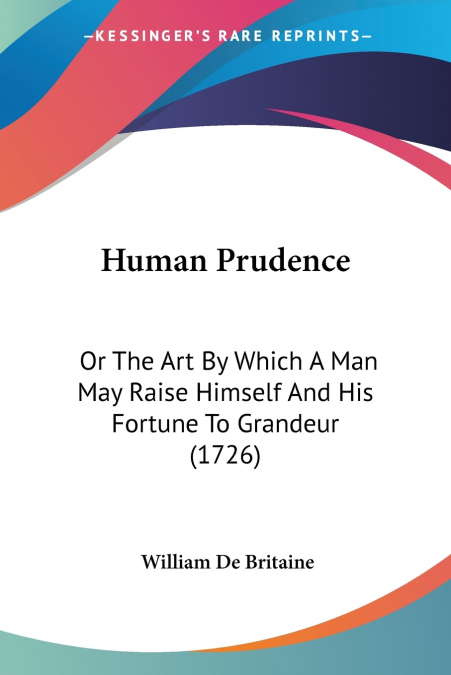

Inicio > Humanidades > Filosofía > Ética y filosofía moral > Menschliche Klugheit Oder Kunst Wodurch Ein Mensch Sich Und Sein Gluck Hoch Empor Bringen Kann (1763)
Menschliche Klugheit Oder Kunst Wodurch Ein Mensch Sich Und Sein Gluck Hoch Empor Bringen Kann (1763)

Menschliche Klugheit Oder Kunst Wodurch Ein Mensch Sich Und Sein Gluck Hoch Empor Bringen Kann (1763)

William De Britaine

36,45 €
IVA incluido
Disponible
Editorial:
Kessinger Publishing
Año de edición:
2009
Materia
Ética y filosofía moral
ISBN:
9781120005212
36,45 €
IVA incluido
Disponible

Selecciona una librería:

  • Librería Desdémona
  • Librería Samer Atenea
  • Librería Aciertas (Toledo)
  • Kálamo Books
  • Librería Perelló (Valencia)
  • Librería Elías (Asturias)
  • Donde los libros
  • Librería Kolima (Madrid)
  • Librería Proteo (Málaga)

''Menschliche Klugheit oder Kunst, wodurch ein Mensch sich und sein Gl�����ck hoch empor bringen kann'' ist ein Buch von William De Britaine, das im Jahr 1763 ver������ffentlicht wurde. Das Werk besch�����ftigt sich mit der menschlichen Intelligenz und der Kunst, die dazu beitragen kann, dass ein Mensch erfolgreich und gl�����cklich wird. Es geht dabei um Themen wie Selbstdisziplin, Strategien zur Verbesserung der eigenen F�����higkeiten und die Bedeutung von Bildung. Das Buch bietet eine umfassende Anleitung, wie man seine St�����rken und Schw�����chen erkennt und wie man seine Ziele erreicht. Es ist ein zeitloses Werk, das auch heute noch relevant ist und vielen Menschen helfen kann, ihr Leben zu verbessern.This Book Is In German.This scarce antiquarian book is a facsimile reprint of the old original and may contain some imperfections such as library marks and notations. Because we believe this work is culturally important, we have made it available as part of our commitment for protecting, preserving, and promoting the world’s literature in affordable, high quality, modern editions, that are true to their original work.

Artículos relacionados

  • Ka Ab Ba Building The Lighted Temple
    Dr Terri R. Nelson
    The book KaAbBa Building The Lighted Temple/Metaphysical Keys to the Tree of Life draws a circle that is inclusive of the Afrikan origin of the Ancient Kemetic/Egyptian wisdom. It reveals the undeniable root and link of Ancient Africa to all the religious systems that would develop worldwide. This book is explosive in its power to convey the meaning of KaAbBa, the Medu Neter  (...
    Disponible

    37,41 €

  • Aquinas, Ethics, and Philosophy of Religion
    Thomas Hibbs
    In Aquinas, Ethics, and Philosophy of Religion, Thomas Hibbs recovers the notion of practice to develop a more descriptive account of human action and knowing, grounded in the venerable vocabulary of virtue and vice. Drawing on Aquinas, who believed that all good works originate from virtue, Hibbs postulates how epistemology, ethics, metaphysics, and theology combine into a set...
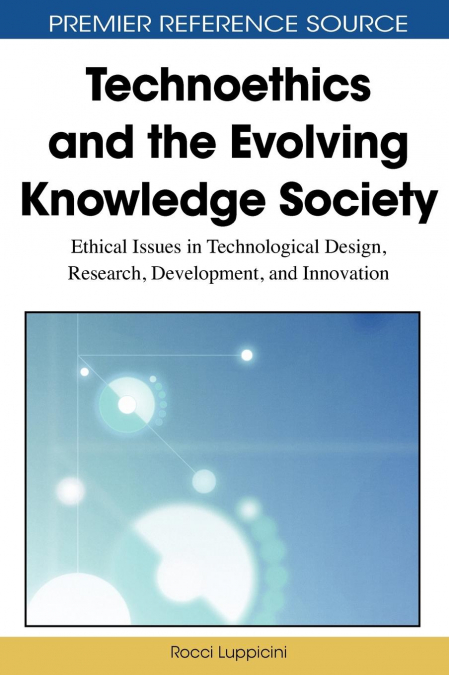
  • Technoethics and the Evolving Knowledge Society
    Rocci Luppicini
    Recently, there has been a major push to rediscover the ethical dimension of technology across the sciences, social sciences, and humanities. Technoethics and the Evolving Knowledge Society: Ethical Issues in Technological Design, Research, Development, and Innovation examines human processes and practices connected to technology embedded within social, political, and moral sph...
    Disponible

    236,22 €

  • Kant
    Immanuel Kant
    Kant’s Groundwork of the Metaphysics of Morals is one of the most important works in modern moral philosophy. It belongs beside Plato, Aristotle, Machiavelli, and Hobbes. Here Kant sets out to articulate and defend the Categorical Imperative - the fundamental principle that underlies moral reasoning - and to lay the foundation for a comprehensive account of justice and human vi...
    Disponible

    20,26 €

  • On the Duty of Civil Disobedience
    HENRY DAVID THOREAU
    Civil Disobedience argues that citizens should not permit their governments to overrule their consciences, and that they have a duty to avoid allowing their acquiescence to enable the government to make them the agents of injustice. Thoreau was motivated in part by his disgust with slavery and the Mexican-American War, but the sentiments he expresses here are just as pertinent ...
    Disponible

    17,75 €

  • Beyond Good and Evil
    Friedrich Nietzsche
    Nietzsche, though primarily a philosopher, wrote widely on art, philology, history, religion, tragedy, culture, and science.  In 1886, at the height of his powers, he published Beyond Good and Evil.  Here he examines much of the best of human thought--dogmatic philosophy, Judeo-Christian morality, science and democracy – and finds it lacking.  Rejecting “slave-morality” he pres...
    Disponible

    20,39 €

Otros libros del autor

  • Human Prudence, Or, the Art by Which a Man and a Woman May Be Advanced to Fortune, to Permanent Honor, and to Real Grandeur
    William De Britaine
    This is a reproduction of the original artefact. Generally these books are created from careful scans of the original. This allows us to preserve the book accurately and present it in the way the author intended. Since the original versions are generally quite old, there may occasionally be certain imperfections within these reproductions. We're happy to make these classics ava...
  • Humane Prudence, or the art by Which a man may Raise Himself and his Fortune to Grandeur. The Tenth Edition, Corrected and Enlarged
    William De Britaine
    The 18th century was a wealth of knowledge, exploration and rapidly growing technology and expanding record-keeping made possible by advances in the printing press. In its determination to preserve the century of revolution, Gale initiated a revolution of its own: digitization of epic proportions to preserve these invaluable works in the largest archive of its kind. Now for the...
  • Humane Prudence
    William De Britaine
    The 18th century was a wealth of knowledge, exploration and rapidly growing technology and expanding record-keeping made possible by advances in the printing press. In its determination to preserve the century of revolution, Gale initiated a revolution of its own: digitization of epic proportions to preserve these invaluable works in the largest archive of its kind. Now for the...
  • Human Prudence
    William De Britaine
    The 18th century was a wealth of knowledge, exploration and rapidly growing technology and expanding record-keeping made possible by advances in the printing press. In its determination to preserve the century of revolution, Gale initiated a revolution of its own: digitization of epic proportions to preserve these invaluable works in the largest archive of its kind. Now for the...
  • Human Prudence
    William De Britaine
    The 18th century was a wealth of knowledge, exploration and rapidly growing technology and expanding record-keeping made possible by advances in the printing press. In its determination to preserve the century of revolution, Gale initiated a revolution of its own: digitization of epic proportions to preserve these invaluable works in the largest archive of its kind. Now for the...
  • Humane Prudence, or the art by Which a man may Raise Himself and his Fortune to Grandeur. The Tenth Edition Corrected and Very Much Enlarged
    William De Britaine
    The 18th century was a wealth of knowledge, exploration and rapidly growing technology and expanding record-keeping made possible by advances in the printing press. In its determination to preserve the century of revolution, Gale initiated a revolution of its own: digitization of epic proportions to preserve these invaluable works in the largest archive of its kind. Now for the...