 Librería Samer Atenea
 Kálamo Books
 Librería Elías (Asturias)
 Librería Kolima (Madrid)
 Librería Proteo (Málaga)
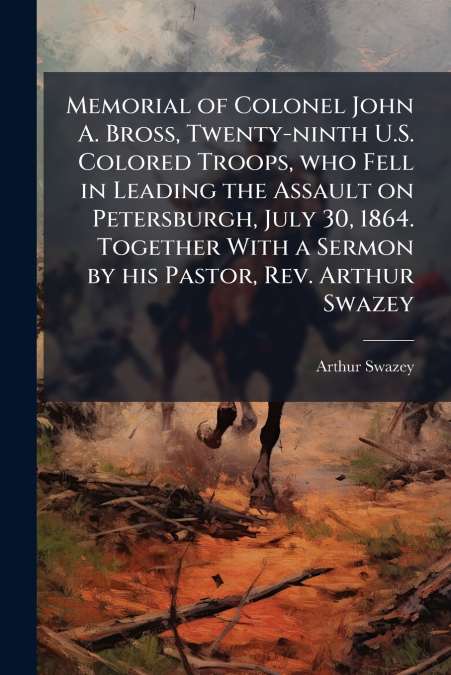
This volume serves as a memorial to Colonel John A. Bross, a leader of the Twenty-ninth U.S. Colored Troops, who died during the assault on Petersburg on July 30, 1864. It commemorates his life and sacrifice during a pivotal moment in the American Civil War. Included is a detailed account of his military service and the circumstances of his death, providing valuable insight into the experiences of African American soldiers during the conflict.Supplementing the biographical details is a sermon delivered by Reverend Arthur Swazey, offering a religious perspective on Bross’s life and death. Together, these elements create a poignant tribute to a fallen hero, reflecting on themes of duty, sacrifice, and the moral dimensions of the war. 'Memorial of Colonel John A. Bross' stands as a testament to the courage and contributions of the U.S. Colored Troops and provides a unique historical perspective on the Civil War era.This work has been selected by scholars as being culturally important, and is part of the knowledge base of civilization as we know it. This work was reproduced from the original artifact, and remains as true to the original work as possible. Therefore, you will see the original copyright references, library stamps (as most of these works have been housed in our most important libraries around the world), and other notations in the work.This work is in the public domain in the United States of America, and possibly other nations. Within the United States, you may freely copy and distribute this work, as no entity (individual or corporate) has a copyright on the body of the work.As a reproduction of a historical artifact, this work may contain missing or blurred pages, poor pictures, errant marks, etc. Scholars believe, and we concur, that this work is important enough to be preserved, reproduced, and made generally available to the public. We appreciate your support of the preservation process, and thank you for being an important part of keeping this knowledge alive and relevant.