Bartolommeo Cardinal 1756-1844 Pacca / L. (Louis) b. 1807 Bellaguet
 Librería Samer Atenea
 Kálamo Books
 Librería Elías (Asturias)
 Librería Kolima (Madrid)
 Librería Proteo (Málaga)
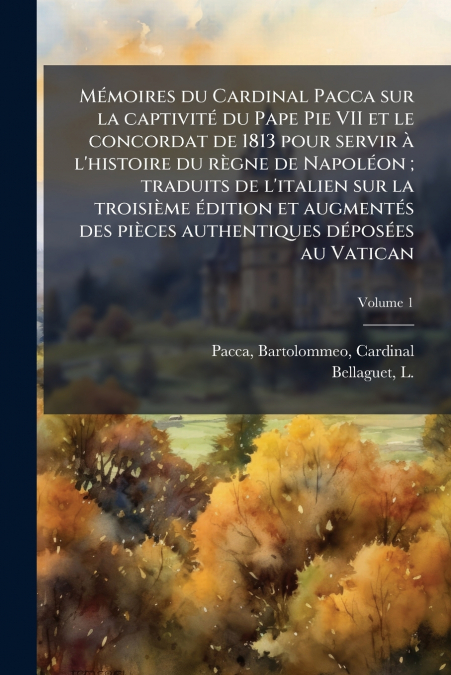
Mémoires du Cardinal Pacca sur la captivité du Pape Pie VII et le concordat de 1813 pour servir à l’histoire du règne de Napoléon, translated from the Italian third edition and augmented with authentic documents deposited in the Vatican, recounts a pivotal period in European history. This first volume offers a detailed firsthand account by Cardinal Bartolomeo Pacca, a key figure in the Papal court, concerning the tumultuous relationship between Pope Pius VII and Napoleon Bonaparte. The memoirs shed light on the Pope’s captivity and the negotiations surrounding the Concordat of 1813, providing invaluable insights into the political and religious tensions of the era. This historical document is essential for understanding the complex interplay between church and state during Napoleon’s reign and the lasting impact of these events on the Catholic Church.This work has been selected by scholars as being culturally important, and is part of the knowledge base of civilization as we know it. This work was reproduced from the original artifact, and remains as true to the original work as possible. Therefore, you will see the original copyright references, library stamps (as most of these works have been housed in our most important libraries around the world), and other notations in the work.This work is in the public domain in the United States of America, and possibly other nations. Within the United States, you may freely copy and distribute this work, as no entity (individual or corporate) has a copyright on the body of the work.As a reproduction of a historical artifact, this work may contain missing or blurred pages, poor pictures, errant marks, etc. Scholars believe, and we concur, that this work is important enough to be preserved, reproduced, and made generally available to the public. We appreciate your support of the preservation process, and thank you for being an important part of keeping this knowledge alive and relevant.