
Inicio > Lenguas > Lingüistica > Meaning in Law
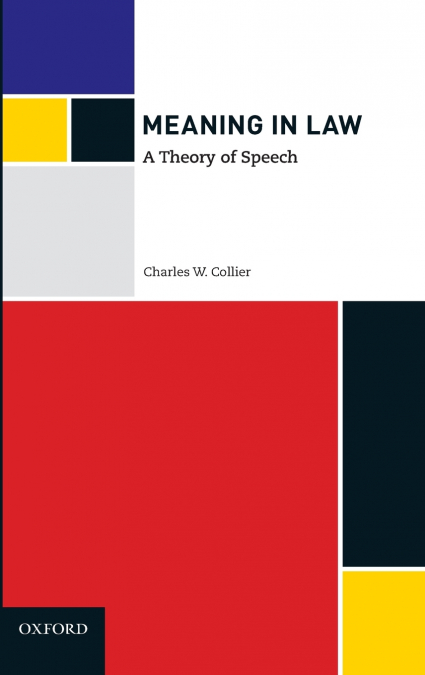
Meaning in Law

Meaning in Law

Charles W Collier

174,12 €
IVA incluido
Consulta disponibilidad
Editorial:
Oxford University Press
Año de edición:
2009
Materia
Lingüistica
ISBN:
9780195388978

Selecciona una librería:

  • Librería Samer Atenea
  • Librería Aciertas (Toledo)
  • Kálamo Books
  • Librería Perelló (Valencia)
  • Librería Elías (Asturias)
  • Donde los libros
  • Librería Kolima (Madrid)
  • Librería Proteo (Málaga)

Despite widespread admiration for the First Amendment's protection of speech, this iconic feature of American legal thought has never been adequately theorized. Existing theories of speech proceed on the basis of legal doctrine and judicial decisionmaking, social and political philosophy, or legal and intellectual history. But these are not the disciplines one would most naturally turn to in analyzing speech. Meaning in Law: A Theory of Speech takes a new and different approach. This book develops a general legal theory of speech on the basis of linguistic theory and thephilosophy of language.The opening chapters retrace the main conceptual stages in the expression of meaning: from natural meaning, through symbolism, to signification. Later chapters analyze symbolic speech (communication by nonlinguistic means) as the key to developing an intention-based theory of speech. The essential elements of the theory are (1) nonnatural meaning, (2) the signaling of intent, (3) the recognition of intent, and (4) establishing a convention.A final chapter applies these insights to the case law of symbolic speech and resolves some basic confusions in the legal literature. This analysis proceeds by way of an original distinction between actual conduct (in the real world) and the "ideal conduct" described in a statute. The former may be described both as communicative andnoncommunicative, while the latter has already been conceptualized as either communicative or noncommunicative. This distinction clears up a major legal quandary: how conduct that counts as communication may nevertheless be regulated or prohibited, without running afoul of the First Amendment's protection of speech.

Artículos relacionados

  • User-Centered Computer Aided Language Learning
    Giorgos Zacharia / Panayiotis Zaphiris
    ...
  • Deep Learning for Natural Language Processing
    Marco Antonio Valenzuela-Escárcega / Mihai Surdeanu
    ...
    Disponible

    47,60 €

  • Deep Learning for Natural Language Processing
    Marco Antonio Valenzuela-Escárcega / Mihai Surdeanu
    ...
  • Lecciones sobre espinosa medrano
    Luis Jaime Cisneros Vizquerra
    La obra de Juan de Espinosa Medrano, apodado en su tiempo «El Lunarejo» (c. 1629-1688), fue uno de los mayores focos de interés académico de Luis Jaime Cisneros (1921-2011). En 1980 aparecieron sus primeros trabajos dedicados a estudiar los textos capitales de Espinosa Medrano (el Apologético en favor de don Luis de Góngora, la Panegírica declamación por la protección de las ci...
    Disponible

    17,63 €

  • Lyre Book
    Matthew Kilbane
    Redefines modern lyric poetry at the intersection of literary and media studies.In The Lyre Book, Matthew Kilbane urges literary scholars to consider lyric not as a genre or a reading practice but as a media condition: the generative tension between writing and sound. In addition to clarifying issues central to the study of modern poetry--including its proximity to popular song...
    Disponible

    50,84 €

  • Translation-mediated Communication in a Digital World
    David Ashworth / Minako O’Hagan
    The Internet is accelerating globalization by exposing organizations and individuals to global audiences. This in turn is driving teletranslation and teleinterpretation, new types of multilingual support, which are functional in digital communications environments. The book describes teletranslation and teleinterpretation by exploring a number of key emerging contexts for langu...
    Disponible

    45,19 €