 Librería Samer Atenea
 Kálamo Books
 Librería Elías (Asturias)
 Librería Kolima (Madrid)
 Librería Proteo (Málaga)
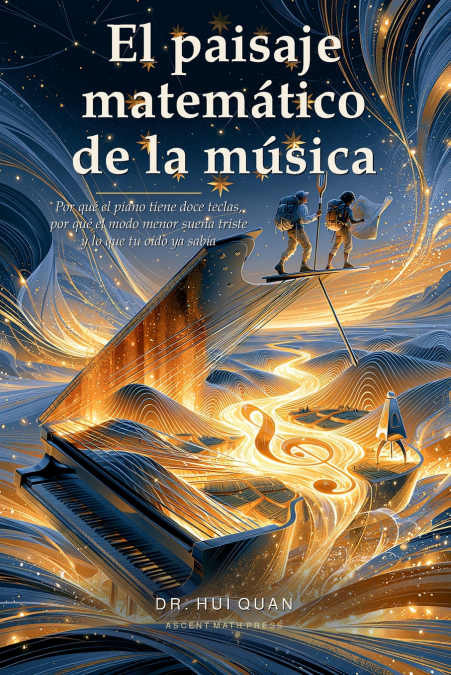
Why does a piano have exactly twelve keys? Why does lowering one note turn a bright chord sad? And what does a leap-year calendar have to do with either question?The Mathematical Landscape of Musicis for readers who’ve always suspected that music and mathematics were never really two subjects - just one idea wearing two costumes.It began with a question from a twelve-year-old violinist that the author, a longtime mathematics teacher, couldn’t answer on the spot:'Why twelve keys? We count in tens.'Chasing down a real answer opened onto a landscape spanning twenty-five centuries - a rounding error older than Euclid, a single ancient algorithm that shows up in piano tuning, the leap-year calendar, and the sweetest chord you’ve ever heard, and a trigonometric identity that quietly decides whether a chord sounds happy or sad.Written in a warm, story-driven voice - part memoir, part detective story, part rigorous-but-friendly math book - it’s built for curious teenagers and lifelong learners alike, whether their instrument is a piano, a proof, or both.Inside the book:No calculus required - just curiosity, and an ear.DR. HUI QUANis as at home at the piano - lost in Chopin and Rachmaninoff - as at the chalkboard, teaching the numbers and geometry beneath the music.The Mathematical Landscape of Musicis his invitation to hear both at once.