
Materiali per la separazione dell’olio e sensore di idrogeno

Materiali per la separazione dell’olio e sensore di idrogeno

Duc Duong La

53,66 €
IVA incluido
Disponible
Editorial:
KS OmniScriptum Publishing
Año de edición:
2025
ISBN:
9786208000431
53,66 €
IVA incluido
Disponible

Selecciona una librería:

  • Librería Samer Atenea
  • Librería Aciertas (Toledo)
  • Kálamo Books
  • Librería Perelló (Valencia)
  • Librería Elías (Asturias)
  • Donde los libros
  • Librería Kolima (Madrid)
  • Librería Proteo (Málaga)

Le proprietà superidrofobiche e superoleofile di 165 gradi si sono mantenute in un ampio intervallo di pH compreso tra 0 e 14 e alla temperatura elevata di 250oC, adatta alla separazione acqua-olio. Il sensore Pt/MWNT è risultato avere una sensibilità massima di 217 μA ppm-1 e un’eccellente risposta lineare alla concentrazione di H2 nell’ampio intervallo 5 - 1000 ppm. Inoltre, questo sensore ha mostrato prestazioni migliori in termini di selettività rispetto agli elettrodi binari a nanoparticelle di Pt-ZnO/MWNT, Pt-Ni/MWNT, Pt-Zn/MWNT e Pt-Pd/MWNT.
Artículos relacionados

  • Recycled Polymers
    Didier Perrin
    The efficient ecodesign of secondary raw materials from recycled multiphase polymer systems is performed through the study of various things, such as:The compatibility of mixtures of recycled polymers where work on knowledge of the miscibility of mixtures depends on the different rates and the nature of the constituents;The aging of recycled polymers in terms of the structuring...
  • Advanced Nanoscale Materials for Thermoelectric Applications
    This Special Issue covers preparations, measurements, devices, and applications based on thermoelectric nanomaterials and summarizes the latest developments towards highly efficient thermoelectric nanomaterials and thermoelectric devices. ...
  • Repair and Strengthening of Existing Reinforced Concrete Structures
    Andreas Lampropoulos
    It is crucial that we strengthen existing structures worldwide, especially in earthquake-prone areas. Recent earthquakes have highlighted the inadequacy of many existing structures, which have been damaged from previous powerful earthquakes and have been designed without code provisions or according to old code provisions that are now obsolete. Furthermore, the majority of exis...
  • Sol-Gel Technology Applied to Materials Science
    Aleksej Zarkov
    Rapid advances in technologies around the globe necessitate the development of new materials, nanostructures, and multicomponent composites with specific chemical and physical properties that can meet the requirements of modern technologies. Using appropriate synthetic approaches is crucial for the preparation of inorganic materials with designed microstructure and properties. ...
  • Functional Polymer Composites
    Functional polymer composites are showing increasing potential as materials in chemistry and materials science. Polymer composites, including nanocomposites, are made via the incorporation of fillers in polymer matrices and offer many advantages. The properties of polymer composites are further improved via the surface modification of fillers or the matrix phase. Currently, the...
  • Feature Papers in Section Biosensors 2023
    Evgeny Katz
    This reprint, based on the Special Issue, provides a general overview of different biosensors, briefly explaining the general approaches to identifying them, their construction, and their performance. A discussion concerning how the required components of biosensors are combined to perform analytical work is presented. Different signal-transducing mechanisms are discussed, part...

Otros libros del autor

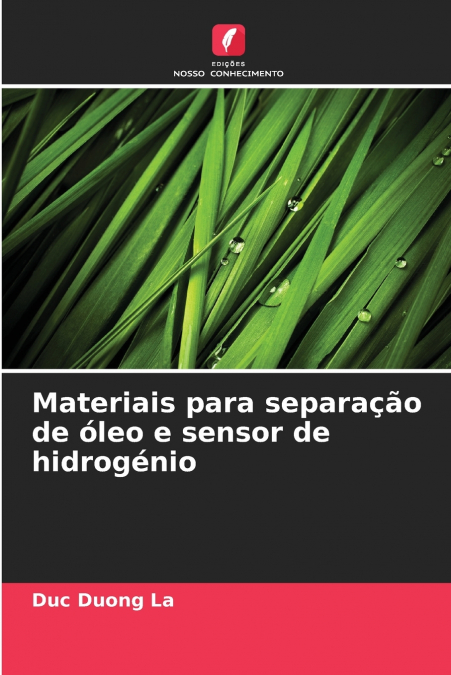
  • Materiais para separação de óleo e sensor de hidrogénio
    Duc Duong La
    Verificou-se que as propriedades superhidrofóbicas e superoleofílicas de 165 graus se mantêm numa ampla gama de pH de 0 a 14 e à alta temperatura de 250 °C, o que é adequado para a separação água-óleo. Verificou-se que o sensor Pt/MWNT tem uma sensibilidade máxima de 217 μA ppm-1 e uma excelente resposta linear à concentração de H2 na ampla faixa de 5 a 1000 ppm. Além disso, es...
    Disponible

    53,73 €

  • Materiały do separacji oleju i czujnik wodoru
    Duc Duong La
    Właściwości superhydrofobowe i superoleofilowe 165 stopni utrzymują się w szerokim zakresie pH od 0 do 14 oraz w wysokiej temperaturze 250oC, co sprawia, że nadają się one do separacji wody i oleju. Czujnik Pt/MWNT wykazał maksymalną czułość 217 μA ppm-1 i doskonałą liniową reakcję na stężenie H2 w szerokim zakresie od 5 do 1000 ppm. Ponadto czujnik ten wykazał lepszą wydajność...
    Disponible

    53,66 €

  • Materialien für die Ölabscheidung und Wasserstoffsensoren
    Duc Duong La
    Die superhydrophoben und superoleophilen Eigenschaften von 165 Grad blieben über einen breiten pH-Bereich von 0 bis 14 und bei einer hohen Temperatur von 250 °C erhalten, was für die Wasser-Öl-Trennung geeignet ist. Der Pt/MWNT-Sensor wies eine maximale Empfindlichkeit von 217 μA ppm-1 und eine ausgezeichnete lineare Reaktion auf die H2-Konzentration in einem breiten Bereich vo...
    Disponible

    53,73 €

  • Matériaux pour la séparation de l’huile et le capteur d’hydrogène
    Duc Duong La
    Les propriétés superhydrophobes et superoléophiles de 165 degrés ont été maintenues dans une large gamme de pH de 0 à 14 et à une température élevée de 250oC, ce qui convient à la séparation eau-huile. Le capteur Pt/MWNT présente une sensibilité maximale de 217 μA ppm-1 et une excellente réponse linéaire à la concentration de H2 dans une large gamme de 5 à 1000 ppm. En outre, c...
    Disponible

    53,73 €