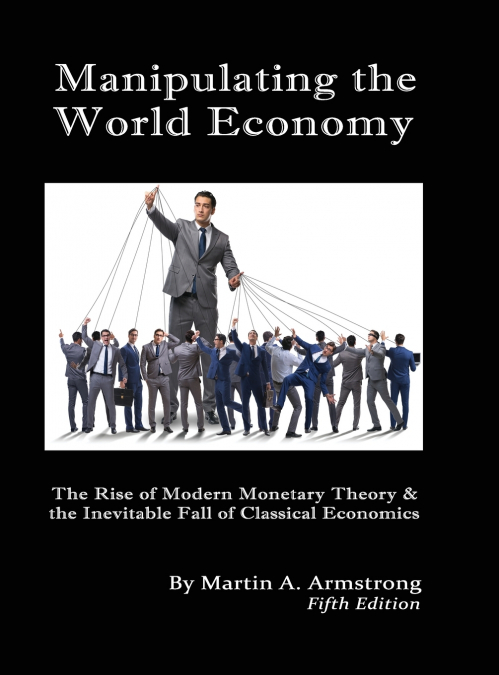
Manipulating the World Economy

Manipulating the World Economy

Martin A. Armstrong / Martin AArmstrong

131,18 €
IVA incluido
Consulta disponibilidad
Editorial:
Gatekeeper Press
Año de edición:
2021
Materia
Historia de la economía
ISBN:
9781662914461

Selecciona una librería:

  • Librería Samer Atenea
  • Librería Aciertas (Toledo)
  • Kálamo Books
  • Librería Perelló (Valencia)
  • Librería Elías (Asturias)
  • Donde los libros
  • Librería Kolima (Madrid)
  • Librería Proteo (Málaga)

The economic theories that dominated the field during the 20th century have failed us and empowered government to believe they can manipulate the business cycle. Every economic theory presented post-Marxism has assumed that the complexity of the business cycle can be reduced to a single cause and effect. To date, no attempt to manipulate the cycle has prevented a recession or financial crisis. We now face a truly monumental crisis. Central banks around the world are trapped. Their attempt to stimulate the economy through Quantitative Easing and rate manipulation has disastrously failed.The central banks have primarily purchased government debt, effectively keeping governments on life support by allowing them to issue new debt at substantially lower rates. In addition to catastrophic Quantitative Easing policies, political fiscal spending on various programs and agencies has burdened governments with a debt that they can never repay. The future crisis is one created by government. This time, we are not likely to fix the problem without major political reform, which all governments will resist. These policies have led many to assume that government can freely create money without inflation. After creating trillions of dollars to buy government debt with no appreciable inflation, many conclude that everything has changed.They are calling this the Modern Monetary Theory. If they are correct, then why bother to have taxes or borrow money continuously with no intention of paying off national debts? Governments, in modern theory, can simply create an endless supply of money to create a new modern version of Utopia. Can we throw away all economic history for an experiment that could unravel civilization if the theory proves to be wrong? What are the risks? Can it really be that easy? Are there any examples from the past that we can look to for answers?
Artículos relacionados

  • Foreign Banks and Global Finance in Modern China
    Ghassan Moazzin
    ...
    Disponible

    41,39 €

  • F.U.B.A.R. From Inflation to Hyperinflation
    Pawlo Lawriw
    Inflation and hyperinflation results in F.U.B.A.R on an epic scale. It can cause social and economic collapse and war and in short, change history- for the worse. If you are worried about inflation, who is not, then F.U.B.A.R. (F****d Up Beyond All Recognition) FROM INFLATION TO HYPERINFLATION is a work that you need to read.Some observers now wonder as society suffers from hig...
    Disponible

    18,47 €

  • Scarce and Valuable Economical Tracts
    John Ramsay McCulloch
    This volume, Scarce and Valuable Economical Tracts, was edited by John Ramsay McCulloch and originally published in 1859. It contains essays on political economy written by: Nicholas Barbon, Daniel Defoe, Henry Elking, Thomas Wise, Benjamin Franklin, Anne Robert Jacques Turgot, James Anderson, Alexander Schomberg, Joseph Townsend, Edmund Burke, and Archibald Bell.In her entry o...
    Disponible

    17,77 €

  • The Winding Road to the Welfare State
    George R. Boyer
    How did Britain transform itself from a nation of workhouses to one that became a model for the modern welfare state? The Winding Road to the Welfare State investigates the evolution of living standards and welfare policies in Britain from the 1830s to 1950 and provides insights into how British working-class households coped with economic insecurity. George Boyer examines the ...
    Disponible

    46,98 €

  • Joseph Alois Schumpeter
    Wolfgang F. Stolper
    In this major scholarly study of the life of Joseph A. Schumpeter, one of the great intellectual figures of the twentieth century, the distinguished economist Wolfgang Stolper delves into the mind of his former teacher, exploring the development of his ideas and, especially, their influence on politics and public policy. After reflecting briefly on Schumpeter the man, Stolper e...
    Disponible

    110,15 €

  • An Economic History of the Iberian Peninsula, 700-2000
    ...

Otros libros del autor

  • The Cycle of War and the Coronavirus
    Martin A. Armstrong / Martin AArmstrong
    The global economy deteriorated in a matter of months due to governments’ mishandling of the coronavirus outbreak. General observers may describe this event as 'unforeseen,' but they fail to look at the patterns of the past that reveal the future. Cyclical behavior dominates every facet of our world, including warfare, civil unrest, and even pandemics. 'The Cycle of War and the...