
Inicio > Derecho > Teoría general del derecho > Making Legal Services Count
Making Legal Services Count

Making Legal Services Count

Gerry Singsen

22,48 €
IVA incluido
Disponible
Editorial:
Jayne Tyrrell
Año de edición:
2026
Materia
Teoría general del derecho
ISBN:
9798992505597
22,48 €
IVA incluido
Disponible

Selecciona una librería:

  • Librería Samer Atenea

  • Kálamo Books
  • Librería Elías (Asturias)
  • Librería Kolima (Madrid)
  • Librería Proteo (Málaga)

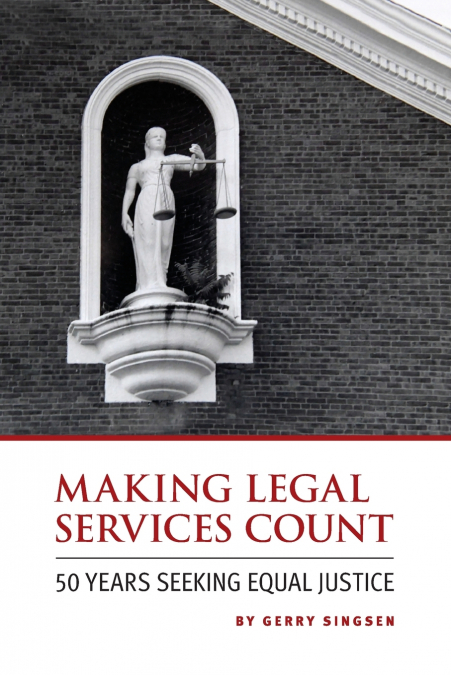
This is the story of a tireless advocate who shaped America’s commitment to provide basic civil legal services to its low-income population. It is a memoir, written for family, friends and people interested in justice for those without means. It is about a young man’s quest to do good in the world; about preventing injustice by assuring poor people have lawyers; and about how a successful social movement for justice is built, re-built, protected, defended and strives always to do better. Gerry came of age when the War on Poverty created local legal services programs to provide civil (non-criminal) legal aid where essentially none had been provided before. His professional life centered around the quest for justice as it came to be embodied in the federal Legal Services Corporation and the local legal aid programs that it spawned in every corner of the country. Gerry shaped national policies guiding federal initiatives, and when our country’s commitment to these legal services was severely attacked, Gerry was at the center of fights to save the federal program, first as an insider at the Legal Services Corporation and later as a leader of a small band of advocates on the outside. He also shaped the local delivery of legal services in the hundreds of local legal aid programs established across the country, first as a neighborhood attorney and as a leader of one of the nation’s biggest legal aid programs, and decades later as a preeminent go-to consultant for community programs around the country in need of expert advice and guidance or simply seeking to provide better and better legal services to those in need.This memoir can be seen as being about the inner workings of any movement striving for more justice with limited resources. Gerry was all about asking tough questions about goals, needs and purpose, and about the nitty gritty of measuring progress. About the mechanics needed to advance the cause of justice and about ways to identify shortcomings and success. About what outcomes are desired and then what can be expected; how to achieve those ends; how to know and measure what has been achieved; how to start the process again and do better. At every stage of Gerry’s career, he asked hard questions that made the legal services movement stronger and that identified shortfalls in order to do better.The very successful creation of a nationally-funded, locally-delivered, legal aid program opened the door to experiments with other means of delivering critical legal services to the vast majority of people without realistic access to lawyers. The reader will hear about how the movement changed law school teaching, gained the support of the organized bar, resulted in state funding where once there was only federal funding; about legal clinics, prepaid legal services insurance plans, law firm pro bono work and the provision of legal services by non-lawyers.This memoir is inspirational; surely Gerry hoped that his telling would inspire others in the quest for legal justice for low-income individuals.


Artículos relacionados

  • EU General Data Protection Regulation (GDPR)
    IT Governance Privacy Team
    An in-depth guide to complying with the EU GDPR.Now in its second edition, EU GDPR – An Implementation and Compliance Guide is a clear and comprehensive guide to this new data protection law, providing a detailed commentary on the Regulation, and setting out the obligations of data  processors and controllers in clear and comprehensible terms.Read this book to learn: How the ...
    Disponible

    30,10 €

  • Banking Laws and Regulations in Nigeria
    Bello Mohammed Magaji
    Banking Law and Regulations in Nigeria: Selected Themes essentially deals with the laid down rules or code of conduct meant to control and set standards for banking business. Indeed, the main aim of the ongoing banking reforms in Nigeria, started in 2004, is to ensure banks’ conformity to the laid down banking rules and regulations. The eleven-chapter book contains vital and ri...
    Disponible

    41,17 €

  • States and the Interpretation of Treaties
    Dimitris Liakopoulos
    States and the Interpretation of Treaties opens with a provocative reconsideration of a debate on the subject of comparative international legal obligations by the United Nations’s International Law Commission. In this book, distinguished Tufts University legal scholar Dimitris Liakopoulos identifies and explores relevant considerations in the work of the Commission and offers ...
  • The role of customs in international treaties
    Dimitris Liakopoulos
    The Role of Customs in International Treaties concentrates on issues of friction between member states of the United Nations. In view of the role played by the United Nations in resolving international disputes, Dimitris Liakopoulos hypothesizes that 'practical guides' based on custom often catalyze the positions taken by states, courts, scholars, and other actors, constituting...
  • Debtor protection in American and European Union bankruptcy law
    Dimitris Liakopoulos
    In Debtor Protection in American and European Union Bankruptcy Law, international law scholar Dimitris Liakopulos raises a delicate issue at the foundations of the modern banking system by analyzing US bankruptcy law with a focus on the concept of automatic stay. His work identifies legal sources and authorities having repercussions in terms of operational protection. It then e...
  • Capital punishment in American courts
    James Biser Whisker / Kevin Spiker
    In the 400 years since the first known execution was carried out for treason in Virginia, American jurisdictions have debated both the appropriateness and methods of capital punishment. Over that time, courts have placed varying restrictions on its application, excluding categories of citizens (for example the insane or the underaged) and evaluating and excluding methods of exe...