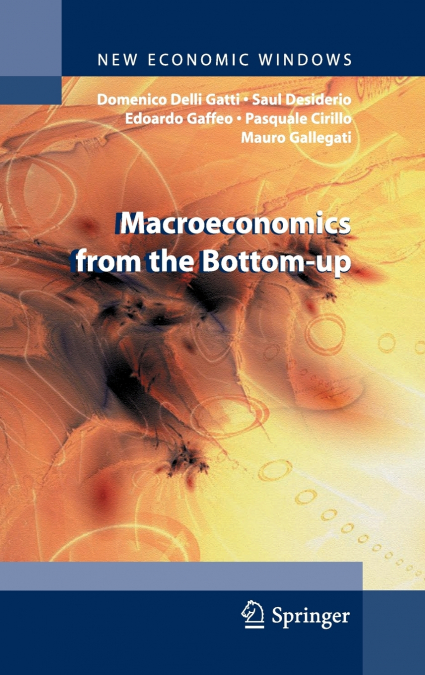
Macroeconomics from the Bottom-up

Macroeconomics from the Bottom-up

Domenico Delli Gatti / Edoardo Gaffeo / Saul Desiderio

68,13 €
IVA incluido
Disponible
Editorial:
Springer Nature B.V.
Año de edición:
2013
Materia
Macroeconomía
ISBN:
9788847025189
68,13 €
IVA incluido
Disponible

Selecciona una librería:

  • Librería Samer Atenea
  • Librería Aciertas (Toledo)
  • Kálamo Books
  • Librería Perelló (Valencia)
  • Librería Elías (Asturias)
  • Donde los libros
  • Librería Kolima (Madrid)
  • Librería Proteo (Málaga)

This book arose from our conviction that the NNS-DSGE approach to the analysis of aggregate market outcomes is fundamentally flawed. The practice of overcoming the SMD result by recurring to a fictitious RA leads to insurmountable methodological problems and lies at the root of DSGE models’ failure to satisfactorily explain real world features, like exchange rate and banking crises, bubbles and herding in financial markets, swings in the sentiment of consumers and entrepreneurs, asymmetries and persistence in aggregate variables, and so on. At odds with this view, our critique rests on the premise that any modern macroeconomy should be modeled instead as a complex system of heterogeneous interacting individuals, acting adaptively and autonomously according to simple and empirically validated rules of thumb.We call our proposed approach Bottom-up Adaptive Macroeconomics (BAM). The reason why we claim that the contents of this book can be inscribed in the realm of macroeconomics is threefold:i) We are looking for a framework that helps us to think coherently about the interrelationships among two or more markets. In what follows, in particular, three markets will be considered: the markets for goods, labor and loanable funds. In this respect, real time matters: what happens in one market depends on what has happened, on what is happening, or on what will happen in other markets. This implies that intertemporal coordination issues cannot be ignored.ii) Eventually, it’s all about prices and quantities. However, we are mostly interested in aggregate prices and quantities, that is indexes built from the dispersed outcomes of the decentralized transactions of a large population of heterogeneous individuals. Each individual acts purposefully, but she knows anything about the levels of prices and quantities which clear markets in the aggregate.iii) In the hope of being allowed to purport scientific claims, BAM relies on the assumption that individual purposeful behaviours aggregates into regularities. Macro behaviour, however, can depart radically from what the individual units are trying to accomplish. It is in this sense that aggregate outcomes emerge from individual actions and interactions.

Artículos relacionados

  • Introduction to Dynamic Macroeconomic General Equilibrium Models
    José Luis Torres Chacon
    This book offers an introductory step-by-step course in Dynamic Stochastic General Equilibrium modelling. Modern macroeconomic analysis is increasingly concerned with the construction, calibration and/or estimation and simulation of Dynamic General Equilibrium (DGE) models. The book is intended for graduate students as an introductory course to DGE modelling and for those econo...
    Disponible

    61,40 €

  • International Education and the Next-Generation Workforce
    Wei Wang
    Education is the first stage in developing a viable, dynamic, and long-lived global economy. Unfortunately, in times of economic hardship, educational programs, teacher salaries, and extracurricular opportunities are often the first to be cut. International Education and the Next-Generation Workforce: Competition in the Global Economy presents a detailed discussion of present e...
  • Macroeconomic Policies of Developed Democracies
    Robert J Franzese Jr
    ...
  • End Of The Road
    Louis Holder
    This book is about the mismanagement of Western economies in pursuit of political power, which resulting devastation will have to be borne by future generations. The book establishes that postponement is no longer doable and lays out the hard choices ahead causing much misery and agony.Although not fully recognized because of masking by asset bubbles, which are spun/sold as in...
    Disponible

    16,42 €

  • The Darwin Economy
    Robert H. Frank
    What Charles Darwin can teach us about building a fairer societyWho was the greater economist-Adam Smith or Charles Darwin? The question seems absurd. Darwin, after all, was a naturalist, not an economist. But Robert Frank, New York Times economics columnist and best-selling author of The Economic Naturalist, predicts that within the next century Darwin will unseat Smith as the...
    Disponible

    22,42 €

  • Myth and Measurement
    Alan B. Krueger / David Card
    From David Card, winner of the Nobel Prize in Economics, and Alan Krueger, a provocative challenge to conventional wisdom about the minimum wageDavid Card and Alan B. Krueger have already made national news with their pathbreaking research on the minimum wage. Here they present a powerful new challenge to the conventional view that higher minimum wages reduce jobs for low-wage ...
    Disponible

    39,64 €

Otros libros del autor