
Inicio > Economía, finanzas, empresa y gestión > Economía > Macroeconomía > Macroeconomic Policy in India Since the Global Financial Crisis
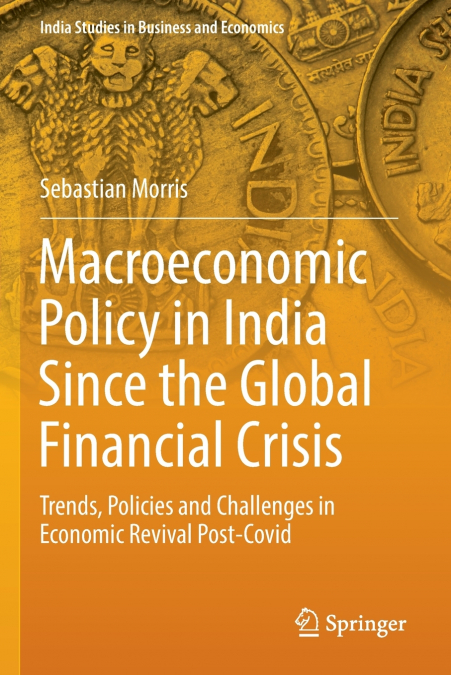
Macroeconomic Policy in India Since the Global Financial Crisis

Macroeconomic Policy in India Since the Global Financial Crisis

Sebastian Morris

148,68 €
IVA incluido
Disponible
Editorial:
Springer Nature B.V.
Año de edición:
2023
Materia
Macroeconomía
ISBN:
9789811912788
148,68 €
IVA incluido
Disponible

Selecciona una librería:

  • Librería Samer Atenea
  • Librería Aciertas (Toledo)
  • Kálamo Books
  • Librería Perelló (Valencia)
  • Librería Elías (Asturias)
  • Donde los libros
  • Librería Kolima (Madrid)
  • Librería Proteo (Málaga)

This book discusses the Indian economic crisis and brings out what went wrong and the correction necessary for getting the economy back to high growth trajectory, leading to economic transformation. To do so, the book covers trends in performance of Indian economy since the Global Financial Crisis to the COVID-19 effect, bringing out factors that have determined the same.The book questions the approach to macroeconomic policy of both the RBI and the government and brings out what it takes for macroeconomic policy to be supportive of high growth. It contains revealing contrasts with East Asia and China, although India has the same potential to grow with an expansion of manufacturing. Overall, it argues that macroeconomic policies (as much as structural, industrial, and trade policies) have been deficient and even good initiatives on the industrial policy and trade flounder for the lack of a strategic approach to macroeconomics. The book highlights the special opportunities present in an emerging economy with vast under and utilised labour and the macroeconomic policy initiatives that can take advantage of this key feature.It covers the macroeconomic data on growth using multiple indicators, then the external shocks and the internal policy measures/responses; besides, GVA/GDP, credit, exports, external transactions, interest and policy rates, yields, exchange rates,  money, capital flows, indices of industrial sector, price indices and inflation, government expenditures, tax rates, fiscal deficits, market uncertainty measures to present a holistic picture of the economy and the shocks and policy actions that have followed. The book uses an innovative method of presentation and the consistency of the trends/stances of both monetary and fiscal policy using these large number of variables. It discusses the debate on overestimation of GDP/GVA growth estimates over the years from 2011-12 to about 2016-17 comprehensively. There is special coverage of GST with a comparison with China. Coverage also includes performance since the COVID-19 crisis again using a large number of indicators and an explanation for the same in terms of the limitations of the government’s initiatives to counteract.The book is a quick and ready reference of what has happened in macroeconomic terms to those interested in the relevant facts. It is of interest to international economists, policy analysts, and investors whose need to understand that the Indian economy in macroeconomic terms and in terms of the stances and penchant of the government and the RBI is of value.
Artículos relacionados

  • Introduction to Dynamic Macroeconomic General Equilibrium Models
    José Luis Torres Chacon
    This book offers an introductory step-by-step course in Dynamic Stochastic General Equilibrium modelling. Modern macroeconomic analysis is increasingly concerned with the construction, calibration and/or estimation and simulation of Dynamic General Equilibrium (DGE) models. The book is intended for graduate students as an introductory course to DGE modelling and for those econo...
    Disponible

    61,40 €

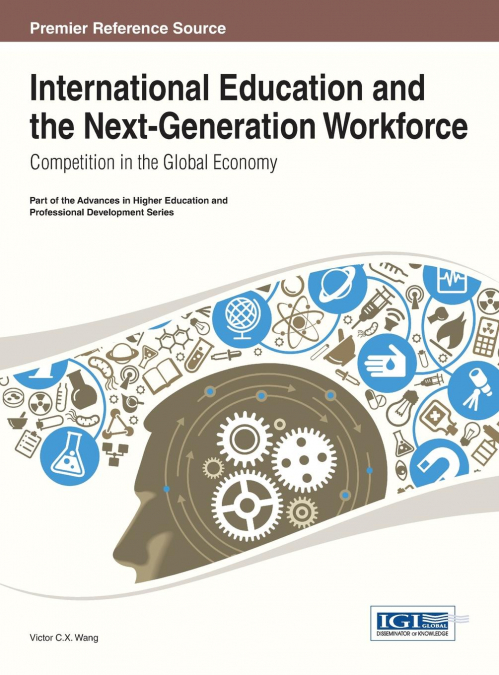
  • International Education and the Next-Generation Workforce
    Wei Wang
    Education is the first stage in developing a viable, dynamic, and long-lived global economy. Unfortunately, in times of economic hardship, educational programs, teacher salaries, and extracurricular opportunities are often the first to be cut. International Education and the Next-Generation Workforce: Competition in the Global Economy presents a detailed discussion of present e...
  • Macroeconomic Policies of Developed Democracies
    Robert J Franzese Jr
    ...
  • End Of The Road
    Louis Holder
    This book is about the mismanagement of Western economies in pursuit of political power, which resulting devastation will have to be borne by future generations. The book establishes that postponement is no longer doable and lays out the hard choices ahead causing much misery and agony.Although not fully recognized because of masking by asset bubbles, which are spun/sold as in...
    Disponible

    16,42 €

  • The Darwin Economy
    Robert H. Frank
    What Charles Darwin can teach us about building a fairer societyWho was the greater economist-Adam Smith or Charles Darwin? The question seems absurd. Darwin, after all, was a naturalist, not an economist. But Robert Frank, New York Times economics columnist and best-selling author of The Economic Naturalist, predicts that within the next century Darwin will unseat Smith as the...
    Disponible

    22,42 €

  • Myth and Measurement
    Alan B. Krueger / David Card
    From David Card, winner of the Nobel Prize in Economics, and Alan Krueger, a provocative challenge to conventional wisdom about the minimum wageDavid Card and Alan B. Krueger have already made national news with their pathbreaking research on the minimum wage. Here they present a powerful new challenge to the conventional view that higher minimum wages reduce jobs for low-wage ...
    Disponible

    39,64 €

Otros libros del autor

  • Macroeconomic Policy in India Since the Global Financial Crisis
    Sebastian Morris
    This book discusses the Indian economic crisis and brings out what went wrong and the correction necessary for getting the economy back to high growth trajectory, leading to economic transformation. To do so, the book covers trends in performance of Indian economy since the Global Financial Crisis to the COVID-19 effect, bringing out factors that have determined the same.The bo...