

 Librería Samer Atenea
 Kálamo Books
 Librería Elías (Asturias)
 Librería Kolima (Madrid)
 Librería Proteo (Málaga)
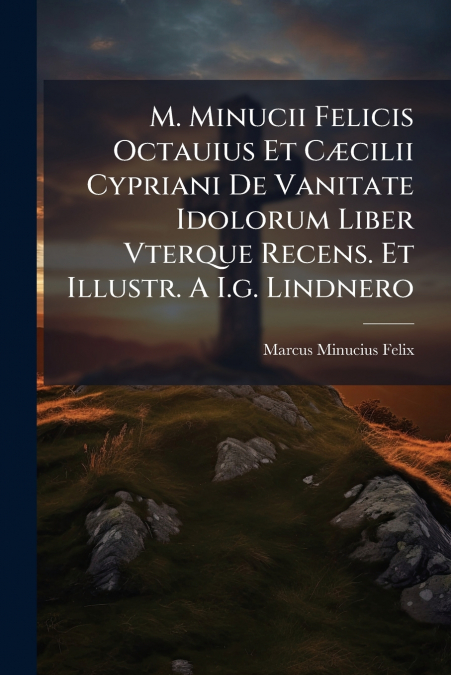
This volume presents the works of Marcus Minucius Felix’s 'Octavius' and Cyprian’s 'De Vanitate Idolorum,' both influential texts from the early Christian era. 'Octavius' is a dialogue defending Christianity against pagan critiques, skillfully employing philosophical arguments and rhetorical techniques to address common misconceptions about Christian beliefs and practices. Cyprian’s 'De Vanitate Idolorum' critiques the emptiness and folly of idolatry, advocating for the abandonment of pagan gods in favor of the one true God. This edition, recently revisited and illuminated by I.G. Lindner, offers readers insights into the intellectual and religious debates of the Roman world, showcasing early Christian efforts to articulate and defend their faith. These texts remain valuable resources for understanding the historical context and theological foundations of early Christianity, and the challenges it faced in its formative years.This work has been selected by scholars as being culturally important, and is part of the knowledge base of civilization as we know it. This work was reproduced from the original artifact, and remains as true to the original work as possible. Therefore, you will see the original copyright references, library stamps (as most of these works have been housed in our most important libraries around the world), and other notations in the work.This work is in the public domain in the United States of America, and possibly other nations. Within the United States, you may freely copy and distribute this work, as no entity (individual or corporate) has a copyright on the body of the work.As a reproduction of a historical artifact, this work may contain missing or blurred pages, poor pictures, errant marks, etc. Scholars believe, and we concur, that this work is important enough to be preserved, reproduced, and made generally available to the public. We appreciate your support of the preservation process, and thank you for being an important part of keeping this knowledge alive and relevant.






![M. Minucii Felicis Octavius, With An Engl. Comm. [&c.] Ed. By H.a. Holden...]( https://distri.podiprint.com/imagenes/978/1/2/7/3/7/8/7/9781273787027_f_675x675.jpg "M. Minucii Felicis Octavius, With An Engl. Comm. [&c.] Ed. By H.a. Holden...")


