
Inicio > Humanidades > Filosofía > Ética y filosofía moral > Lying and Perjury in Medieval Practical Thought
Lying and Perjury in Medieval Practical Thought

Lying and Perjury in Medieval Practical Thought

Emily Corran

147,93 €
IVA incluido
Consulta disponibilidad
Editorial:
Oxford University Press
Año de edición:
2018
Materia
Ética y filosofía moral
ISBN:
9780198828884

Selecciona una librería:

  • Librería Samer Atenea
  • Librería Aciertas (Toledo)
  • Kálamo Books
  • Librería Perelló (Valencia)
  • Librería Elías (Asturias)
  • Donde los libros
  • Librería Kolima (Madrid)
  • Librería Proteo (Málaga)

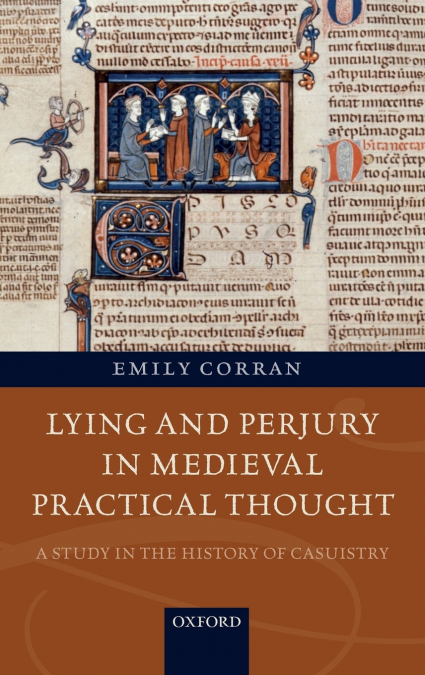
Thought about lying and perjury became increasingly practical from the end of the twelfth century in Western Europe. At this time, a distinctive way of thinking about deception and false oaths appeared in the schools of Paris and Bologna, most notably in the Summa de Sacramentis et Animae Consiliis of Peter the Chanter. This kind of thought was concerned with moral dilemmas and the application of moral rules in exceptional cases. It was a tradition which continued in pastoral writings of the thirteenth century, the practical moral questions addressed by theologians in universities in the second half of the thirteenth century, and in the Summae de Casibus Conscientiae of the late Middle Ages. Lying and Perjury in Medieval Practical Thought argues that medieval practical ethics of this sort can usefully be described as casuistry - a term for the discipline of moral theology that became famous during the Counter-Reformation. This can be seen in the origins of the concept of equivocation, an idea that was explored in medieval literature with varying degrees of moral ambiguity. From the turn of the thirteenth century, the concept was adopted by canon lawyers and theologians, as a means of exploring questions about exceptional situations in ethics. It has been assumed in the past that equivocation, and the casuistry of lying was an academic discourse invented in the sixteenth century in order to evade moral obligations. This study reveals that casuistry in the Middle Ages was developed in ecclesiastical thought as part of an effort to explain how to follow moral rules in ambiguous and perplexing cases.
Artículos relacionados

  • Ka Ab Ba Building The Lighted Temple
    Dr Terri R. Nelson / Dr Terri RNelson
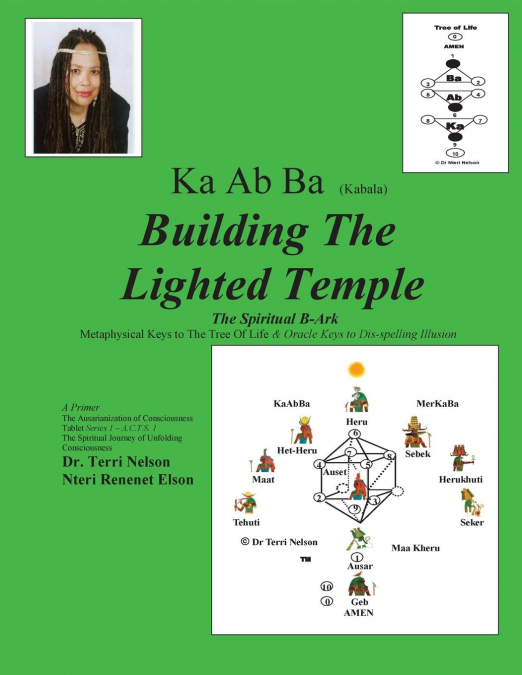
    The book KaAbBa Building The Lighted Temple/Metaphysical Keys to the Tree of Life draws a circle that is inclusive of the Afrikan origin of the Ancient Kemetic/Egyptian wisdom. It reveals the undeniable root and link of Ancient Africa to all the religious systems that would develop worldwide. This book is explosive in its power to convey the meaning of KaAbBa, the Medu Neter  (...
    Disponible

    37,41 €

  • Technoethics and the Evolving Knowledge Society
    Rocci Luppicini
    Recently, there has been a major push to rediscover the ethical dimension of technology across the sciences, social sciences, and humanities. Technoethics and the Evolving Knowledge Society: Ethical Issues in Technological Design, Research, Development, and Innovation examines human processes and practices connected to technology embedded within social, political, and moral sph...
  • Kant
    Immanuel Kant
    Kant’s Groundwork of the Metaphysics of Morals is one of the most important works in modern moral philosophy. It belongs beside Plato, Aristotle, Machiavelli, and Hobbes. Here Kant sets out to articulate and defend the Categorical Imperative - the fundamental principle that underlies moral reasoning - and to lay the foundation for a comprehensive account of justice and human vi...
  • On the Duty of Civil Disobedience
    HENRY DAVID THOREAU
    Civil Disobedience argues that citizens should not permit their governments to overrule their consciences, and that they have a duty to avoid allowing their acquiescence to enable the government to make them the agents of injustice. Thoreau was motivated in part by his disgust with slavery and the Mexican-American War, but the sentiments he expresses here are just as pertinent ...
  • Beyond Good and Evil
    Friedrich Nietzsche
    Nietzsche, though primarily a philosopher, wrote widely on art, philology, history, religion, tragedy, culture, and science.  In 1886, at the height of his powers, he published Beyond Good and Evil.  Here he examines much of the best of human thought--dogmatic philosophy, Judeo-Christian morality, science and democracy – and finds it lacking.  Rejecting “slave-morality” he pres...
  • Beyond Good and Evil
    Friedrich Nietzsche
    Nietzsche, though primarily a philosopher, wrote widely on art, philology, history, religion, tragedy, culture, and science.  In 1886, at the height of his powers, he published Beyond Good and Evil.  Here he examines much of the best of human thought--dogmatic philosophy, Judeo-Christian morality, science and democracy – and finds it lacking.  Rejecting “slave-morality” he pres...
    Disponible

    9,99 €