 Librería Samer Atenea
 Kálamo Books
 Librería Elías (Asturias)
 Librería Kolima (Madrid)
 Librería Proteo (Málaga)
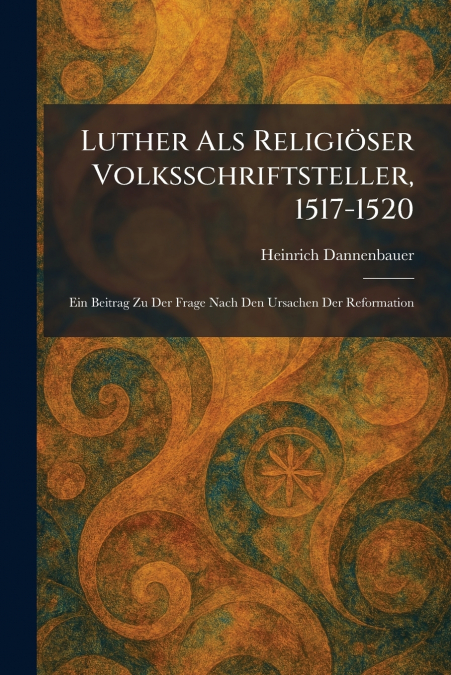
'Luther Als Religiöser Volksschriftsteller, 1517-1520' untersucht die entscheidende Rolle Martin Luthers als Verfasser populärer religiöser Texte in den frühen Jahren der Reformation. Heinrich Dannenbauer analysiert in diesem Werk, wie Luthers schriftstellerisches Wirken zwischen dem Anschlag der Thesen und seinem endgültigen Bruch mit Rom zur Mobilisierung der Massen beitrug. Der Autor beleuchtet die sprachliche Gewalt und die theologische Zugänglichkeit von Luthers Schriften, die weit über akademische Kreise hinaus wirkten und somit einen wesentlichen Faktor für den Erfolg der reformatorischen Bewegung darstellten.Das Werk bietet eine tiefgreifende historische Analyse der Ursachen der Reformation, indem es den Fokus auf die mediale Vermittlung religiöser Ideen legt. Es zeigt auf, wie Luther komplexe theologische Fragen in die Sprache des Volkes übersetzte und dadurch eine beispiellose gesellschaftliche Dynamik auslöste. 'Luther Als Religiöser Volksschriftsteller, 1517-1520' ist ein unverzichtbarer Beitrag zum Verständnis der Kirchengeschichte und der deutschen Literaturgeschichte des 16. Jahrhunderts.This work has been selected by scholars as being culturally important, and is part of the knowledge base of civilization as we know it. This work was reproduced from the original artifact, and remains as true to the original work as possible. Therefore, you may see the original copyright references, library stamps (as most of these works have been housed in our most important libraries around the world), and other notations in the work.This work is in the public domain in the United States of America, and possibly other nations. Within the United States, you may freely copy and distribute this work, as no entity (individual or corporate) has a copyright on the body of the work.As a reproduction of a historical artifact, this work may contain missing or blurred pages, poor pictures, errant marks, etc. Scholars believe, and we concur, that this work is important enough to be preserved, reproduced, and made generally available to the public. We appreciate your support of the preservation process, and thank you for being an important part of keeping this knowledge alive and relevant.