 Librería Samer Atenea
 Kálamo Books
 Librería Elías (Asturias)
 Librería Kolima (Madrid)
 Librería Proteo (Málaga)
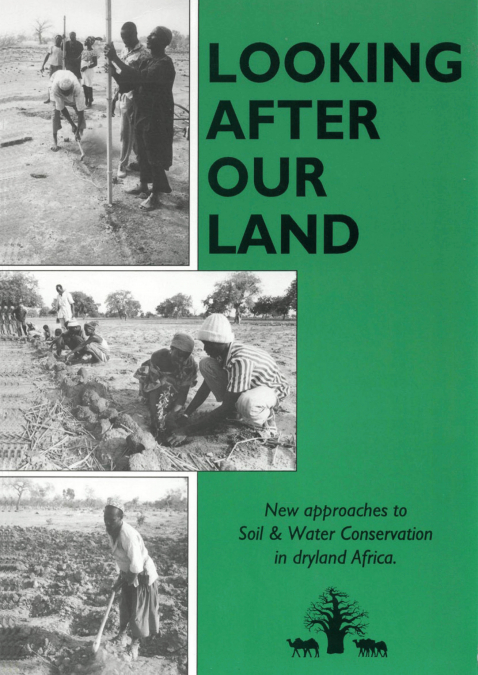
’Desertification’ is not the creation of a desert - or very rarely! It is a process of resource degradation. Helping people to acquire the tools, knowledge and confidence the need to reverse this process is one of the major challenges facing development workers in arid and semi-arid Africa. Soil conservation projects in sub-Saharan Africa have had a troubled record over the past 30 years or so, and their failure has had extremely serious consequences, especially for those people living in the dry land areas. Two main factors have contributed to the failure of these projects. First, for marginal farmers, the idea of ’preventing future loss of soils’ is irrelevant to present needs, and second, the farmers themselves have, in the past, simply not been consulted about their knowledge and understanding of the process of erosion. Both traditional technology and social organisation have usually been ignored, and solutions have been imposed from above. This has led to such ’solutions’, even where they show some technical merit, never being taken up with enthusiasm by local communities and fading into oblivion when the project itself finishes. However, in the last decade a number of interesting developments have taken place. With the help of a handful of projects, people across Africa have demonstrated that they are motivated, competent and capable of taking charge of their environment and its protection. There is and growing evidence that when local communities are sufficiently involved in planning and implementation, these soil and water conservation activities can be, and are sustained beyond the life of the initiating project. In late 1989, the Arid Lands Information Network based at Oxfam and the Drylands Programme at IIED shared their growing concern at the very small amount of resource material on soil and water conservation being produced by and for development workers at project level despite the great demand for relevant information. ALIN and IIED decided to collaborate on the production of a video with accompanying notes to try and fill the gap. The ’accompanying notes’ turned into a book...and here it is. This book is about the main lessons to be learnt from new approaches to soil and water conservation in sub-Saharan Africa. It presents six case studies, two each from Burkina Faso, Kenya and Mali, where soil and water conservation, based on the participation of the local people, has resulted in some success. The book brings out the essential ingredients of a successful soil and water conservation project and provides a set of questions which should be asked before embarking on such a programme - not a fixed list of steps to take, but some important point to remember. The fieldwork for the book was carried out during 1990, and descriptions of project work and progress therefore obviously relate to the projects at that stage. It is written expressly for development workers in arid and semi-arid Africa, on whose experience it is based.