
Inicio > > Redes y comunicaciones informáticas > Logics for Databases and Information Systems
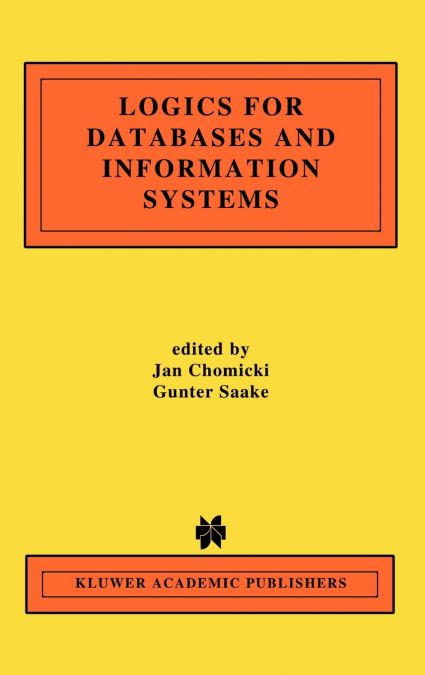
Logics for Databases and Information Systems

Logics for Databases and Information Systems


267,08 €
IVA incluido
Consulta disponibilidad
Editorial:
Springer Nature B.V.
Año de edición:
1998
Materia
Redes y comunicaciones informáticas
ISBN:
9780792381297

Selecciona una librería:

  • Librería Samer Atenea
  • Librería Aciertas (Toledo)
  • Kálamo Books
  • Librería Perelló (Valencia)
  • Librería Elías (Asturias)
  • Donde los libros
  • Librería Kolima (Madrid)
  • Librería Proteo (Málaga)

Time is ubiquitous in information systems. Almost every enterprise faces the problem of its data becoming out of date. However, such data is often valu­ able, so it should be archived and some means to access it should be provided. Also, some data may be inherently historical, e.g., medical, cadastral, or ju­ dicial records. Temporal databases provide a uniform and systematic way of dealing with historical data. Many languages have been proposed for tem­ poral databases, among others temporal logic. Temporal logic combines ab­ stract, formal semantics with the amenability to efficient implementation. This chapter shows how temporal logic can be used in temporal database applica­ tions. Rather than presenting new results, we report on recent developments and survey the field in a systematic way using a unified formal framework [GHR94; Ch094]. The handbook [GHR94] is a comprehensive reference on mathematical foundations of temporal logic. In this chapter we study how temporal logic is used as a query and integrity constraint language. Consequently, model-theoretic notions, particularly for­ mula satisfaction, are of primary interest. Axiomatic systems and proof meth­ ods for temporal logic [GHR94] have found so far relatively few applications in the context of information systems. Moreover, one needs to bear in mind that for the standard linearly-ordered time domains temporal logic is not re­ cursively axiomatizable [GHR94]’ so recursive axiomatizations are by necessity incomplete.
Artículos relacionados

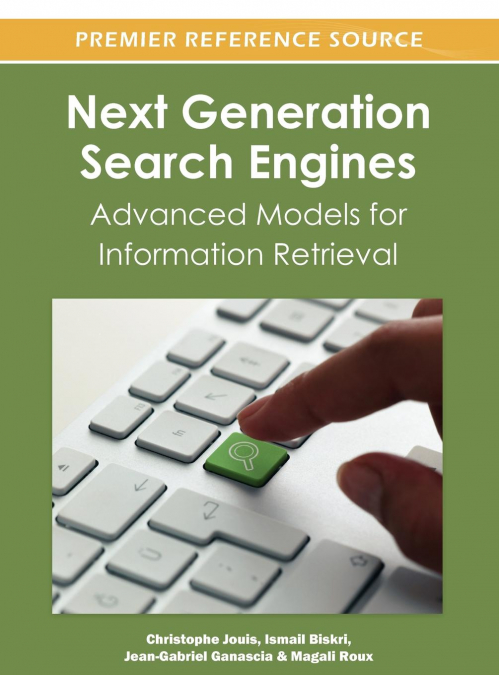
  • Next Generation Search Engines
    Recent technological progress in computer science, Web technologies, and the constantly evolving information available on the Internet has drastically changed the landscape of search and access to information. Current search engines employ advanced techniques involving machine learning, social networks, and semantic analysis. Next Generation Search Engines: Advanced Models for ...
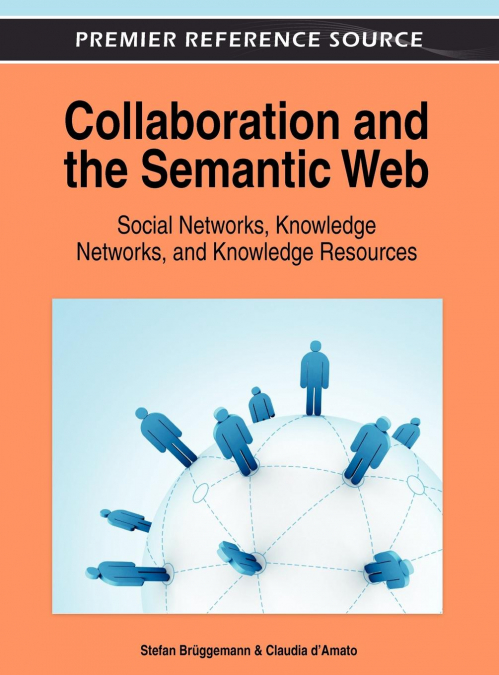
  • Collaboration and the Semantic Web
    Collaborative working has been increasingly viewed as a good practice for organizations to achieve efficiency. Organizations that work well in collaboration may have access to new sources of funding, deliver new, improved, and more integrated services, make savings on shared costs, and exchange knowledge, information and expertise. Collaboration and the Semantic Web: Social Net...
  • Resource Allocation in Next-Generation Broadband Wireless Access Networks
    With the growing popularity of wireless networks in recent years, the need to increase network capacity and efficiency has become more prominent in society. This has led to the development and implementation of heterogeneous networks. Resource Allocation in Next-Generation Broadband Wireless Access Networks is a comprehensive reference source for the latest scholarly research o...
  • Advanced Topics in Information Technology Standards and Standardization Research, Volume 1
    Kai Jakobs
    ...
  • Data Warehouses and OLAP
    ...
  • Selected Readings on Database Technologies and Applications
    Terry Halpin
    Education and research in the field of database technology can prove problematic without the proper resources and tools on the most relevant issues, trends, and advancements. Selected Readings on Database Technologies and Applications supplements course instruction and student research with quality chapters focused on key issues concerning the development, design, and analysis ...