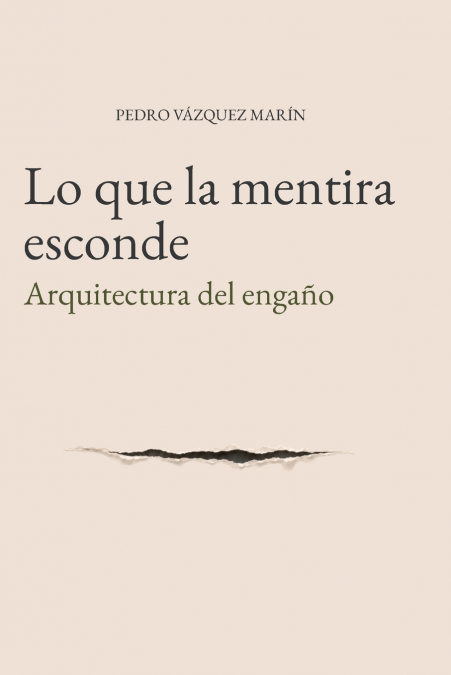

Lo que la mentira esconde

Lo que la mentira esconde

Pedro Vázquez Marín

37,34 €
IVA incluido
Disponible
Editorial:
PDAC Publishing
Año de edición:
2026
Materia
Ética y filosofía moral
ISBN:
9791399062229
37,34 €
IVA incluido
Disponible

Selecciona una librería:

  • Librería Samer Atenea
  • Kálamo Books
  • Librería Elías (Asturias)
  • Librería Kolima (Madrid)
  • Librería Proteo (Málaga)

Una mentira puede comenzar como una frase breve, casi insignificante. Una versión dicha en el momento adecuado, con el tono suficiente, ante las personas precisas. Pero cuando esa versión prende, ya no altera solo un hecho: modifica vínculos, reorganiza silencios, desplaza lealtades y puede convertir a una persona en alguien que no reconoce.Lo que la mentira esconde. Arquitectura del engaño es un ensayo sobre una de las capacidades más inquietantes de la condición humana: la posibilidad de fabricar realidades. Desde la mentira cotidiana hasta la manipulación institucional, desde el autoengaño hasta la posverdad, desde las ficciones que sostienen la convivencia hasta aquellas que destruyen reputaciones, relaciones y vidas, este libro recorre la arquitectura invisible del engaño.Pedro Vázquez Marín escribe desde una experiencia personal atravesada por una mentira devastadora, pero el libro no es una defensa personal ni un ajuste de cuentas. Es una indagación sobre por qué mentimos, cómo se construye la credibilidad, de qué manera una versión falsa puede ocupar el lugar de lo real y qué precio paga quien intenta sostener la verdad cuando el relato dominante ya se ha impuesto.A través de la filosofía, la psicología, la sociología, la neurociencia, la historia y el pensamiento moral, el autor aborda la mentira como fenómeno humano, social e institucional. El resultado es una obra directa, reflexiva y profundamente personal sobre la verdad, el daño, el silencio, el poder y la necesidad de recuperar lucidez cuando una falsedad intenta ocupar el lugar de lo real.Un ensayo sobre la mentira, pero también sobre la dignidad de no permitir que otros escriban para siempre quién eres.
Artículos relacionados

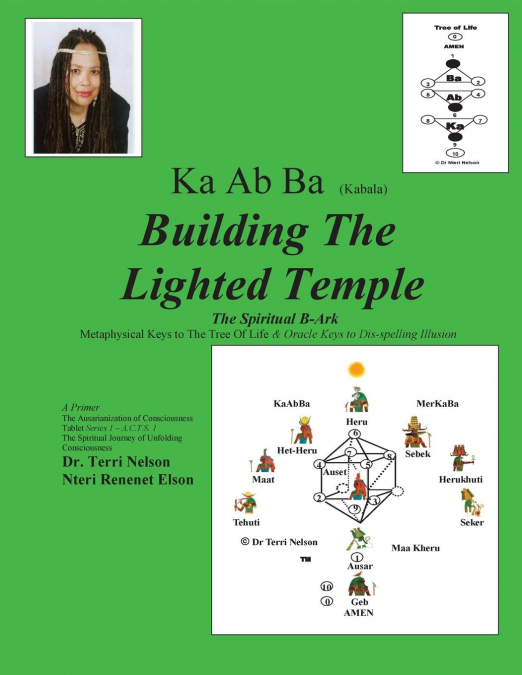
  • Ka Ab Ba Building The Lighted Temple
    Dr Terri R. Nelson / Dr Terri RNelson
    The book KaAbBa Building The Lighted Temple/Metaphysical Keys to the Tree of Life draws a circle that is inclusive of the Afrikan origin of the Ancient Kemetic/Egyptian wisdom. It reveals the undeniable root and link of Ancient Africa to all the religious systems that would develop worldwide. This book is explosive in its power to convey the meaning of KaAbBa, the Medu Neter  (...
    Disponible

    37,41 €

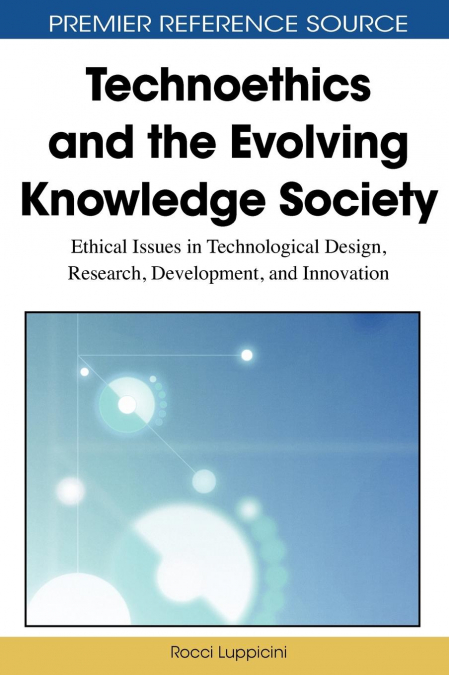
  • Technoethics and the Evolving Knowledge Society
    Rocci Luppicini
    Recently, there has been a major push to rediscover the ethical dimension of technology across the sciences, social sciences, and humanities. Technoethics and the Evolving Knowledge Society: Ethical Issues in Technological Design, Research, Development, and Innovation examines human processes and practices connected to technology embedded within social, political, and moral sph...
  • Kant
    Immanuel Kant
    Kant’s Groundwork of the Metaphysics of Morals is one of the most important works in modern moral philosophy. It belongs beside Plato, Aristotle, Machiavelli, and Hobbes. Here Kant sets out to articulate and defend the Categorical Imperative - the fundamental principle that underlies moral reasoning - and to lay the foundation for a comprehensive account of justice and human vi...
  • On the Duty of Civil Disobedience
    HENRY DAVID THOREAU
    Civil Disobedience argues that citizens should not permit their governments to overrule their consciences, and that they have a duty to avoid allowing their acquiescence to enable the government to make them the agents of injustice. Thoreau was motivated in part by his disgust with slavery and the Mexican-American War, but the sentiments he expresses here are just as pertinent ...
  • Beyond Good and Evil
    Friedrich Nietzsche
    Nietzsche, though primarily a philosopher, wrote widely on art, philology, history, religion, tragedy, culture, and science.  In 1886, at the height of his powers, he published Beyond Good and Evil.  Here he examines much of the best of human thought--dogmatic philosophy, Judeo-Christian morality, science and democracy – and finds it lacking.  Rejecting “slave-morality” he pres...
  • Beyond Good and Evil
    Friedrich Nietzsche
    Nietzsche, though primarily a philosopher, wrote widely on art, philology, history, religion, tragedy, culture, and science.  In 1886, at the height of his powers, he published Beyond Good and Evil.  Here he examines much of the best of human thought--dogmatic philosophy, Judeo-Christian morality, science and democracy – and finds it lacking.  Rejecting “slave-morality” he pres...
    Disponible

    9,99 €