
Inicio > Economía, finanzas, empresa y gestión > Economía > Teoría y filosofía económicas > Litigation and Settlement in a Game with Incomplete Information
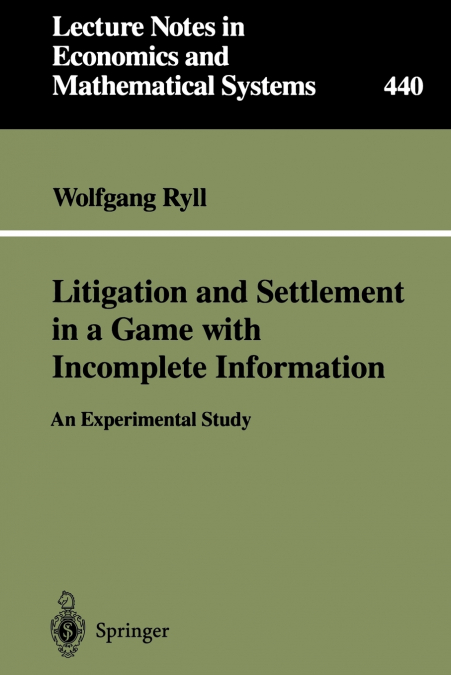
Litigation and Settlement in a Game with Incomplete Information

Litigation and Settlement in a Game with Incomplete Information

Wolfgang Ryll

66,75 €
IVA incluido
Disponible
Editorial:
Springer Nature B.V.
Año de edición:
1996
Materia
Teoría y filosofía económicas
ISBN:
9783540613046
66,75 €
IVA incluido
Disponible

Selecciona una librería:

  • Librería Samer Atenea
  • Librería Aciertas (Toledo)
  • Kálamo Books
  • Librería Perelló (Valencia)
  • Librería Elías (Asturias)
  • Donde los libros
  • Librería Kolima (Madrid)
  • Librería Proteo (Málaga)

We investigate a two-person game of litigation and settlement with incomplete information on one side. So far, various theoretical attempts have been made to answer the question of why some people choose not to resolve their disputes and instead go to court and incur litigation costs, even if bargaining leaves room for both parties to fare better when avoiding the conflict. We can distinguish between games which focus on strategic elements like games with incomplete information (see, for example, P’ng (1983), Samuelson (1982) and Schweizer (1989 and decision-theoretic models neglecting strategic elements (see, for example, Landes (1971) and Gould (1973. The single-person decision theory approach to litigation assumes litigants to have a subjective estimate of the likelihood that the plaintiff will win the action. Differing views on the probability of winning the court case help to explain the fraction of cases that actually go to trial. Among others, P’ng (1983) points out the shortcomings of the single-person decision theory approach which does not take into account, for example, the different fee systems in England and the U.S. and the differences in information conflicting parties may have. P’ng constructs a model of one-sided incomplete information where the settlement terms are given exogenously. Schweizer (1989), on the other hand, extends P’ng’s model and allows for two-sided asymmetric information where the settlement terms are determined endogenously.
Artículos relacionados

  • Navigating the Waters
    Thirdy Ventenilla
    Embark on a journey through the intricate waters of international law and maritime regulations with "Navigating the Waters." This comprehensive guide delves into the depths of the legal frameworks governing our oceans, offering a nuanced understanding of the complex issues shaping our maritime world. From territorial disputes to piracy, from environmental conservation to techno...
    Disponible

    32,99 €

  • Third Party Funding
    Gian Marco Solas
    ...
    Disponible

    49,97 €

  • The American Influence on International Commercial Arbitration
    Pedro J. Martinez-Fraga
    ...
    Disponible

    56,41 €

  • Transboundary Water Disputes
    Itzchak E. Kornfeld
    ...
    Disponible

    45,19 €

  • ’Fair and Equitable Treatment’ in International Investment Law
    Roland Kl Ger / Roland Klager
    ...
  • Effective Mediation Advocacy
    Andrew Goodman
    Updated with Churchill, the Singapore Convention 2019, the impact of Brexit and the pandemic and other important developments in mind, this fourth edition of Andrew Goodman’s original work on mediation advocacy remains essential reading. Practitioners already representing parties at mediation will want their updated bible. For those seeking to add value to their existing practi...
    Disponible

    72,47 €