 Librería Samer Atenea
 Kálamo Books
 Librería Elías (Asturias)
 Librería Kolima (Madrid)
 Librería Proteo (Málaga)
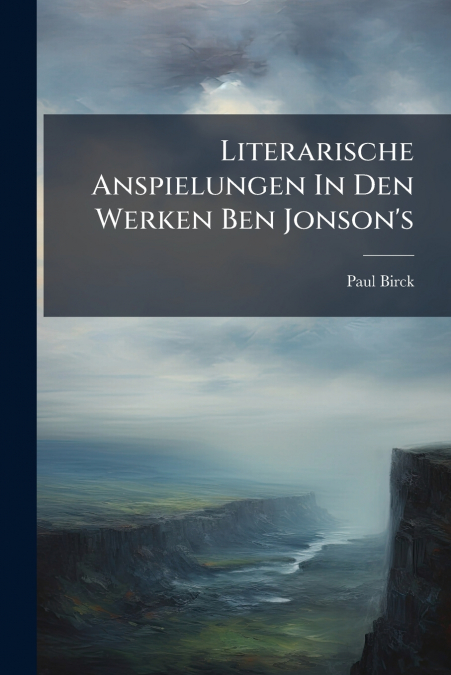
Explore the intricate web of literary allusions woven throughout the works of Ben Jonson in Paul Birck’s insightful study, 'Literarische Anspielungen In Den Werken Ben Jonson’s.' This book meticulously examines Jonson’s plays and poems, revealing the depth and breadth of his engagement with classical and contemporary literature. Birck’s analysis illuminates how Jonson used allusions to enrich his narratives, comment on societal norms, and engage in literary dialogues with his peers. Readers will gain a deeper appreciation for Jonson’s intellectual prowess and the cultural context in which he wrote. Discover how Jonson strategically employed allusions to create layers of meaning, enhance character development, and underscore thematic concerns. This book is an invaluable resource for scholars and students of English literature, Renaissance drama, and the works of Ben Jonson, offering fresh perspectives on his enduring legacy.This work has been selected by scholars as being culturally important, and is part of the knowledge base of civilization as we know it. This work was reproduced from the original artifact, and remains as true to the original work as possible. Therefore, you will see the original copyright references, library stamps (as most of these works have been housed in our most important libraries around the world), and other notations in the work.This work is in the public domain in the United States of America, and possibly other nations. Within the United States, you may freely copy and distribute this work, as no entity (individual or corporate) has a copyright on the body of the work.As a reproduction of a historical artifact, this work may contain missing or blurred pages, poor pictures, errant marks, etc. Scholars believe, and we concur, that this work is important enough to be preserved, reproduced, and made generally available to the public. We appreciate your support of the preservation process, and thank you for being an important part of keeping this knowledge alive and relevant.