 Librería Samer Atenea
 Kálamo Books
 Librería Elías (Asturias)
 Librería Kolima (Madrid)
 Librería Proteo (Málaga)
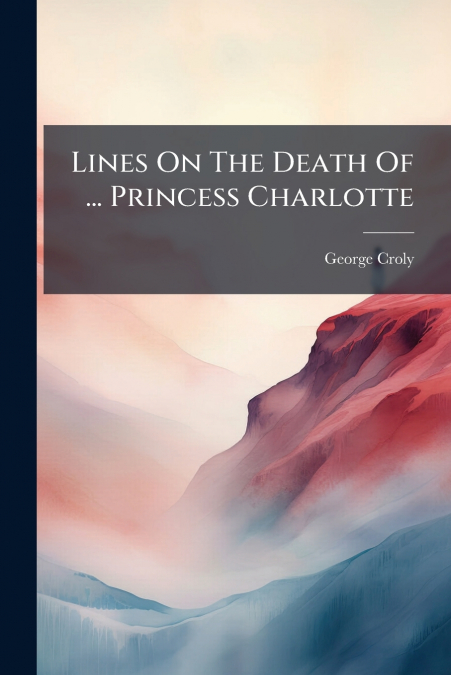
'Lines On The Death Of ... Princess Charlotte' is a poignant poetic tribute by George Croly commemorating the passing of Princess Charlotte of Wales. This elegy captures the profound grief and mourning that swept across Britain upon the untimely death of the beloved princess. Croly’s verses reflect not only the personal tragedy of a young life cut short but also the broader implications for the British monarchy and national identity. The poem serves as a historical document, offering insights into the public sentiment and cultural values of the early 19th century. Croly’s work stands as a testament to the enduring power of poetry to articulate collective emotions and memorialize significant historical events, making it a valuable resource for those interested in British history, royal biographies, and the elegiac tradition in English literature.This work has been selected by scholars as being culturally important, and is part of the knowledge base of civilization as we know it. This work was reproduced from the original artifact, and remains as true to the original work as possible. Therefore, you will see the original copyright references, library stamps (as most of these works have been housed in our most important libraries around the world), and other notations in the work.This work is in the public domain in the United States of America, and possibly other nations. Within the United States, you may freely copy and distribute this work, as no entity (individual or corporate) has a copyright on the body of the work.As a reproduction of a historical artifact, this work may contain missing or blurred pages, poor pictures, errant marks, etc. Scholars believe, and we concur, that this work is important enough to be preserved, reproduced, and made generally available to the public. We appreciate your support of the preservation process, and thank you for being an important part of keeping this knowledge alive and relevant.