

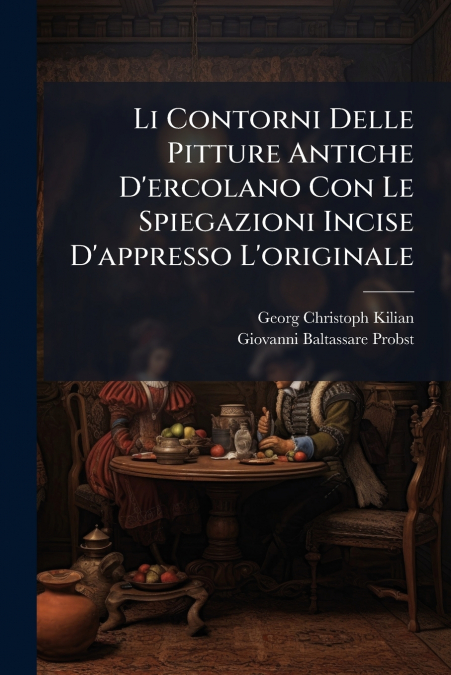
Georg Christoph Kilian / Giovanni Baltassare Probst
 Librería Samer Atenea
 Kálamo Books
 Librería Elías (Asturias)
 Librería Kolima (Madrid)
 Librería Proteo (Málaga)
'Li Contorni Delle Pitture Antiche D’ercolano Con Le Spiegazioni Incise D’appresso L’originale' offers a detailed look at the ancient paintings discovered in Herculaneum. This volume provides engravings and explanations that offer insights into the artistic techniques and styles of the Roman era. The work captures the contours and details of the paintings, serving as a valuable resource for art historians, archaeologists, and anyone interested in classical art and the cultural heritage of ancient Rome.The meticulous documentation by Georg Christoph Kilian and Giovanni Baltassare Probst ensures the preservation of these significant artworks, providing a window into the past. This book serves as a tangible link to the artistic achievements of a bygone era. The meticulous engravings allow modern readers to appreciate the skill and artistry of the original painters.This work has been selected by scholars as being culturally important, and is part of the knowledge base of civilization as we know it. This work was reproduced from the original artifact, and remains as true to the original work as possible. Therefore, you will see the original copyright references, library stamps (as most of these works have been housed in our most important libraries around the world), and other notations in the work.This work is in the public domain in the United States of America, and possibly other nations. Within the United States, you may freely copy and distribute this work, as no entity (individual or corporate) has a copyright on the body of the work.As a reproduction of a historical artifact, this work may contain missing or blurred pages, poor pictures, errant marks, etc. Scholars believe, and we concur, that this work is important enough to be preserved, reproduced, and made generally available to the public. We appreciate your support of the preservation process, and thank you for being an important part of keeping this knowledge alive and relevant.





