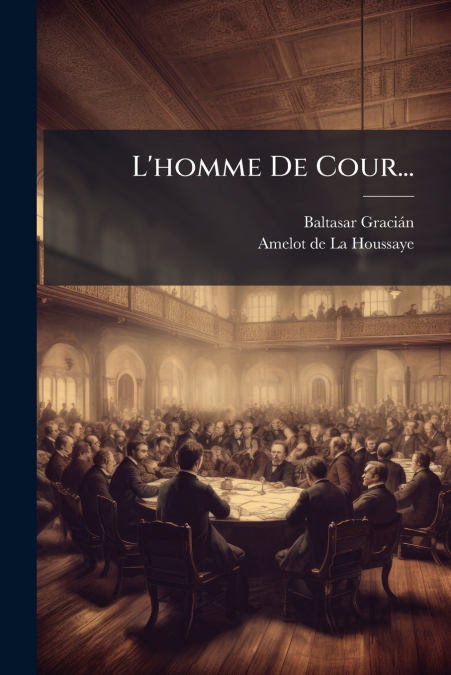
Baltasar Gracián / Amelot de La Houssaye
 Librería Samer Atenea
 Kálamo Books
 Librería Elías (Asturias)
 Librería Kolima (Madrid)
 Librería Proteo (Málaga)
L’Homme De Cour, by Baltasar Gracián, translated and annotated by Amelot de La Houssaye, explores the art of navigating courtly life in 17th-century Europe. This edition brings Gracián’s astute observations on human nature and strategic interaction to a French-speaking audience. Gracián delves into the qualities necessary for success and survival within the intricate social hierarchies of the court. With keen insight, he examines the virtues of prudence, discretion, and the mastery of appearances, offering guidance on how to cultivate influence and maintain favor in a world driven by ambition and intrigue. Amelot de La Houssaye’s translation provides context and enhances the accessibility of Gracián’s work, making it a valuable resource for understanding the dynamics of power and the pursuit of excellence in any era.This work has been selected by scholars as being culturally important, and is part of the knowledge base of civilization as we know it. This work was reproduced from the original artifact, and remains as true to the original work as possible. Therefore, you will see the original copyright references, library stamps (as most of these works have been housed in our most important libraries around the world), and other notations in the work.This work is in the public domain in the United States of America, and possibly other nations. Within the United States, you may freely copy and distribute this work, as no entity (individual or corporate) has a copyright on the body of the work.As a reproduction of a historical artifact, this work may contain missing or blurred pages, poor pictures, errant marks, etc. Scholars believe, and we concur, that this work is important enough to be preserved, reproduced, and made generally available to the public. We appreciate your support of the preservation process, and thank you for being an important part of keeping this knowledge alive and relevant.