
Inicio > Lenguas > Lingüistica > Lexical Semantics of the Arabic Verb
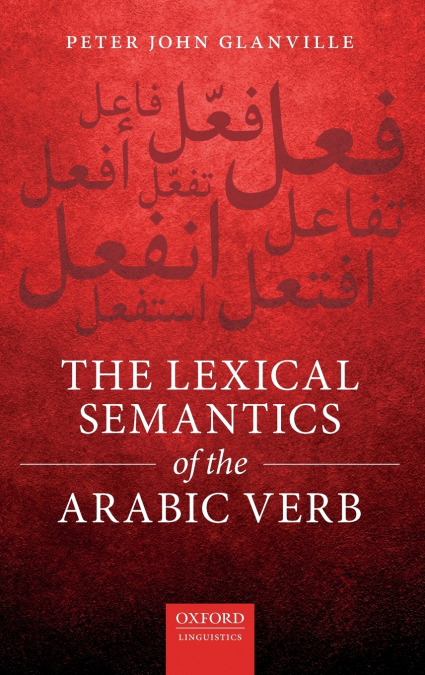
Lexical Semantics of the Arabic Verb

Lexical Semantics of the Arabic Verb

Peter John Glanville

180,59 €
IVA incluido
Consulta disponibilidad
Editorial:
Oxford University Press
Año de edición:
2018
Materia
Lingüistica
ISBN:
9780198792734

Selecciona una librería:

  • Librería Samer Atenea
  • Librería Aciertas (Toledo)
  • Kálamo Books
  • Librería Perelló (Valencia)
  • Librería Elías (Asturias)
  • Donde los libros
  • Librería Kolima (Madrid)
  • Librería Proteo (Málaga)

This book is an investigation of Arabic derivational morphology that focuses on the relationship between verb meaning and linguistic form. Beginning with the ground form, the book offers a comprehensive analysis of the most common verb patterns of Arabic from a lexical semantic perspective. Peter Glanville explains why verbs with seemingly unrelated meanings share the same phonological shape, and analyses sets of words that contain the same consonantal root to arrive at a common abstraction. He uses both contemporary and historical data to explore the semantics of reflexivity, symmetry, causation, and repetition, and argues that the verb patterns of Arabic that express these phenomena have come about as the result of grammaticalization and analogical processes that are common cross-linguistically. The book adopts an approach to morphology in which rule-based derivation has created word patterns and consonantal roots, with the result that in some derivations roots may be extractedfrom a source word and plugged in to a pattern. It illustrates the semantic relationship between a source word and its derivative, while also offering evidence to support the view of the consonantal root as a morphological object. The volume will be a valuable resource for advanced undergraduate and graduate students of Arabic language and linguistics who are interested in understanding the verb patterns of Arabic, the derivational relationships between words, and the construction of meaning in the mind. It will also appeal to researchers and students in morphology, semantics, historical linguistics, and cognitive linguistics.
Artículos relacionados

  • User-Centered Computer Aided Language Learning
    Giorgos Zacharia / Panayiotis Zaphiris
    ...
  • Deep Learning for Natural Language Processing
    Marco Antonio Valenzuela-Escárcega / Mihai Surdeanu
    ...
    Disponible

    47,60 €

  • Deep Learning for Natural Language Processing
    Marco Antonio Valenzuela-Escárcega / Mihai Surdeanu
    ...
  • Lecciones sobre espinosa medrano
    Luis Jaime Cisneros Vizquerra
    La obra de Juan de Espinosa Medrano, apodado en su tiempo «El Lunarejo» (c. 1629-1688), fue uno de los mayores focos de interés académico de Luis Jaime Cisneros (1921-2011). En 1980 aparecieron sus primeros trabajos dedicados a estudiar los textos capitales de Espinosa Medrano (el Apologético en favor de don Luis de Góngora, la Panegírica declamación por la protección de las ci...
    Disponible

    17,63 €

  • Lyre Book
    Matthew Kilbane
    Redefines modern lyric poetry at the intersection of literary and media studies.In The Lyre Book, Matthew Kilbane urges literary scholars to consider lyric not as a genre or a reading practice but as a media condition: the generative tension between writing and sound. In addition to clarifying issues central to the study of modern poetry--including its proximity to popular song...
    Disponible

    50,84 €

  • Translation-mediated Communication in a Digital World
    David Ashworth / Minako O’Hagan
    The Internet is accelerating globalization by exposing organizations and individuals to global audiences. This in turn is driving teletranslation and teleinterpretation, new types of multilingual support, which are functional in digital communications environments. The book describes teletranslation and teleinterpretation by exploring a number of key emerging contexts for langu...
    Disponible

    45,19 €