Inicio > Lenguas > Lingüistica > Lexical Semantics and Knowledge Representation in Multilingual Text Generation
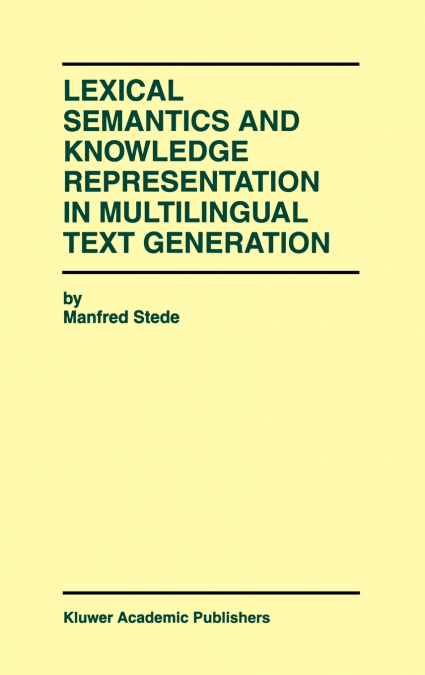
Lexical Semantics and Knowledge Representation in Multilingual Text Generation

Lexical Semantics and Knowledge Representation in Multilingual Text Generation

Manfred Stede

207,94 €
IVA incluido
Disponible
Editorial:
Springer Nature B.V.
Año de edición:
2012
Materia
Lingüistica
ISBN:
9781461373599
207,94 €
IVA incluido
Disponible

Selecciona una librería:

  • Librería Samer Atenea
  • Librería Aciertas (Toledo)
  • Kálamo Books
  • Librería Perelló (Valencia)
  • Librería Elías (Asturias)
  • Donde los libros
  • Librería Kolima (Madrid)
  • Librería Proteo (Málaga)

In knowledge-based natural language generation, issues of formal knowledge representation meet with the linguistic problems of choosing the most appropriate verbalization in a particular situation of utterance. Lexical Semantics and Knowledge Representation in Multilingual Text Generation presents a new approach to systematically linking the realms of lexical semantics and knowledge represented in a description logic. For language generation from such abstract representations, lexicalization is taken as the central step: when choosing words that cover the various parts of the content representation, the principal decisions on conveying the intended meaning are made. A preference mechanism is used to construct the utterance that is best tailored to parameters representing the context. Lexical Semantics and Knowledge Representation in Multilingual Text Generation develops the means for systematically deriving a set of paraphrases from the same underlying representation with the emphasis on events and verb meaning. Furthermore, the same mapping mechanism is used to achieve multilingual generation: English and German output are produced in parallel, on the basis of an adequate division between language-neutral and language-specific (lexical and grammatical) knowledge. Lexical Semantics and Knowledge Representation in Multilingual Text Generation provides detailed insights into designing the representations and organizing the generation process. Readers with a background in artificial intelligence, cognitive science, knowledge representation, linguistics, or natural language processing will find a model of language production that can be adapted to a variety of purposes.

Artículos relacionados

  • User-Centered Computer Aided Language Learning
    Giorgos Zacharia / Panayiotis Zaphiris
    ...
    Disponible

    112,14 €

  • Deep Learning for Natural Language Processing
    Marco Antonio Valenzuela-Escárcega / Mihai Surdeanu
    ...
    Disponible

    47,60 €

  • Deep Learning for Natural Language Processing
    Marco Antonio Valenzuela-Escárcega / Mihai Surdeanu
    ...
    Disponible

    144,63 €

  • Lecciones sobre espinosa medrano
    Luis Jaime Cisneros Vizquerra
    La obra de Juan de Espinosa Medrano, apodado en su tiempo «El Lunarejo» (c. 1629-1688), fue uno de los mayores focos de interés académico de Luis Jaime Cisneros (1921-2011). En 1980 aparecieron sus primeros trabajos dedicados a estudiar los textos capitales de Espinosa Medrano (el Apologético en favor de don Luis de Góngora, la Panegírica declamación por la protección de las ci...
    Disponible

    17,63 €

  • Lyre Book
    Matthew Kilbane
    Redefines modern lyric poetry at the intersection of literary and media studies.In The Lyre Book, Matthew Kilbane urges literary scholars to consider lyric not as a genre or a reading practice but as a media condition: the generative tension between writing and sound. In addition to clarifying issues central to the study of modern poetry--including its proximity to popular song...
    Disponible

    50,84 €

  • Translation-mediated Communication in a Digital World
    David Ashworth / Minako O’Hagan
    The Internet is accelerating globalization by exposing organizations and individuals to global audiences. This in turn is driving teletranslation and teleinterpretation, new types of multilingual support, which are functional in digital communications environments. The book describes teletranslation and teleinterpretation by exploring a number of key emerging contexts for langu...
    Disponible

    45,19 €

Otros libros del autor

  • Discourse Processing
    Manfred Stede
    Discourse Processing here is framed as marking up a text with structural descriptions on several levels, which can serve to support many language-processing or text-mining tasks. We first explore some ways of assigning structure on the document level: the logical document structure as determined by the layout of the text, its genre-specific content structure, and its breakdown ...
    Disponible

    54,44 €

  • Lexical Semantics and Knowledge Representation in Multilingual Text Generation
    Manfred Stede
    In knowledge-based natural language generation, issues of formal knowledge representation meet with the linguistic problems of choosing the most appropriate verbalization in a particular situation of utterance. Lexical Semantics and Knowledge Representation in Multilingual Text Generation presents a new approach to systematically linking the real...
    Disponible

    206,59 €