Johann Joachim 1717-1768 Winckelmann
 Librería Samer Atenea
 Kálamo Books
 Librería Elías (Asturias)
 Librería Kolima (Madrid)
 Librería Proteo (Málaga)
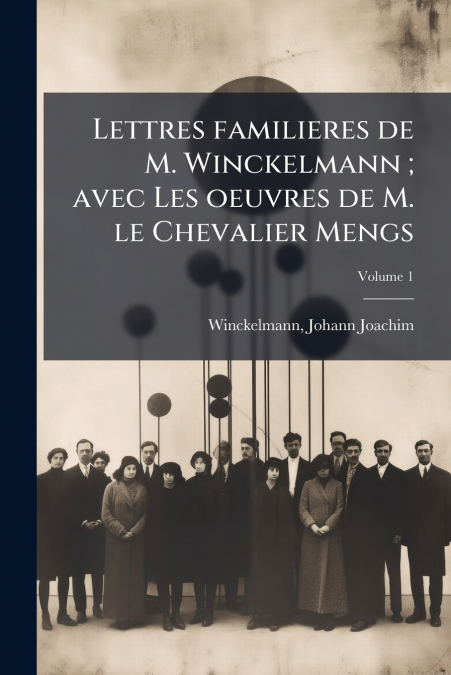
This third volume of 'Lettres familières de M. Winckelmann' presents a collection of personal letters by Johann Joachim Winckelmann, the eminent 18th-century German art historian and archaeologist, alongside the works of the celebrated painter Anton Raphael Mengs. These letters offer a unique window into Winckelmann’s thoughts, experiences, and relationships, providing invaluable insights into the development of his groundbreaking theories on classical art and aesthetics. Readers will discover firsthand accounts of Winckelmann’s travels, his interactions with prominent figures of the time, and his evolving understanding of ancient art. The inclusion of Mengs’ works enriches the collection, highlighting the artistic context in which Winckelmann’s ideas flourished. This volume is essential reading for anyone interested in the history of art, the Enlightenment, and the development of Neoclassicism.This work has been selected by scholars as being culturally important, and is part of the knowledge base of civilization as we know it. This work was reproduced from the original artifact, and remains as true to the original work as possible. Therefore, you will see the original copyright references, library stamps (as most of these works have been housed in our most important libraries around the world), and other notations in the work.This work is in the public domain in the United States of America, and possibly other nations. Within the United States, you may freely copy and distribute this work, as no entity (individual or corporate) has a copyright on the body of the work.As a reproduction of a historical artifact, this work may contain missing or blurred pages, poor pictures, errant marks, etc. Scholars believe, and we concur, that this work is important enough to be preserved, reproduced, and made generally available to the public. We appreciate your support of the preservation process, and thank you for being an important part of keeping this knowledge alive and relevant.