 Librería Samer Atenea
 Kálamo Books
 Librería Elías (Asturias)
 Librería Kolima (Madrid)
 Librería Proteo (Málaga)
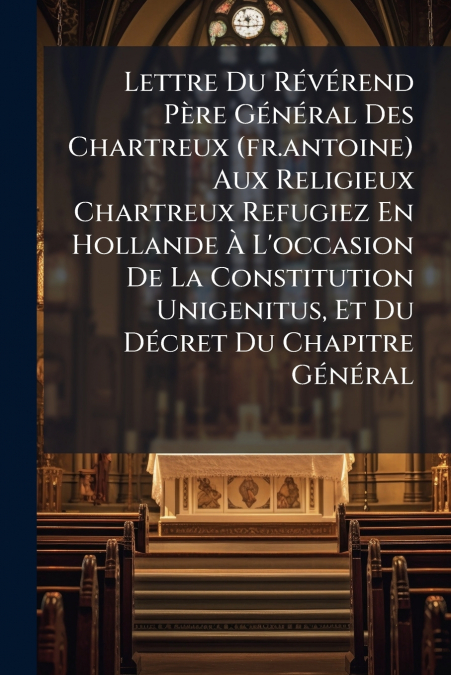
'Lettre Du Révérend Père Général Des Chartreux (fr.antoine) Aux Religieux Chartreux Refugiez En Hollande À L’occasion De La Constitution Unigenitus, Et Du Décret Du Chapitre Général' offers a glimpse into the religious and political turmoil of 18th-century France. This letter, penned by the Father General of the Carthusians, addresses Carthusian monks who sought refuge in Holland due to the controversy surrounding the papal bull Unigenitus. The Unigenitus bull, intended to condemn Jansenism, sparked widespread dissent and division within the Catholic Church in France.This historical document sheds light on the impact of the Unigenitus controversy on religious orders and the broader French society. It provides valuable insights into the complexities of religious conflict and the challenges faced by those who sought to uphold their beliefs in the face of ecclesiastical pressure. The letter serves as a testament to the enduring power of faith and the resilience of individuals during times of religious upheaval.This work has been selected by scholars as being culturally important, and is part of the knowledge base of civilization as we know it. This work was reproduced from the original artifact, and remains as true to the original work as possible. Therefore, you will see the original copyright references, library stamps (as most of these works have been housed in our most important libraries around the world), and other notations in the work.This work is in the public domain in the United States of America, and possibly other nations. Within the United States, you may freely copy and distribute this work, as no entity (individual or corporate) has a copyright on the body of the work.As a reproduction of a historical artifact, this work may contain missing or blurred pages, poor pictures, errant marks, etc. Scholars believe, and we concur, that this work is important enough to be preserved, reproduced, and made generally available to the public. We appreciate your support of the preservation process, and thank you for being an important part of keeping this knowledge alive and relevant.