David Stewart Erskine Buchan (Earl of)
 Librería Samer Atenea
 Kálamo Books
 Librería Elías (Asturias)
 Librería Kolima (Madrid)
 Librería Proteo (Málaga)
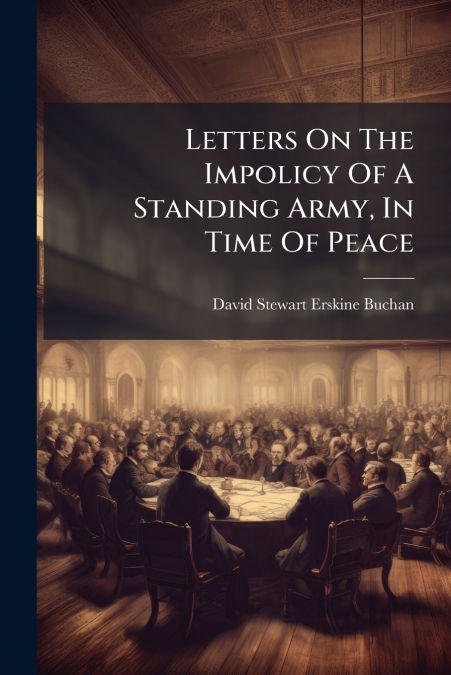
In 'Letters On The Impolicy Of A Standing Army, In Time Of Peace,' David Stewart Erskine Buchan, the Earl of Buchan, presents a compelling argument against the establishment of a permanent military force during peacetime. This historical work delves into the unconstitutional nature and potential dangers of maintaining barracks, offering a robust critique rooted in principles of liberty and civic responsibility. Buchan’s analysis provides an insightful examination of alternative defense strategies more aligned with constitutional ideals. The text includes a short review emphasizing a mode of defense deemed constitutionally sound for the island, appealing to readers interested in historical political discourse and military policy. This edition revives a crucial debate on the balance between national security and individual freedoms, relevant for scholars and enthusiasts of political science and military history.This work has been selected by scholars as being culturally important, and is part of the knowledge base of civilization as we know it. This work was reproduced from the original artifact, and remains as true to the original work as possible. Therefore, you will see the original copyright references, library stamps (as most of these works have been housed in our most important libraries around the world), and other notations in the work.This work is in the public domain in the United States of America, and possibly other nations. Within the United States, you may freely copy and distribute this work, as no entity (individual or corporate) has a copyright on the body of the work.As a reproduction of a historical artifact, this work may contain missing or blurred pages, poor pictures, errant marks, etc. Scholars believe, and we concur, that this work is important enough to be preserved, reproduced, and made generally available to the public. We appreciate your support of the preservation process, and thank you for being an important part of keeping this knowledge alive and relevant.