Henry Ashworth / Anthony Ashley Cooper Shaftesbury (Earl
 Librería Samer Atenea
 Kálamo Books
 Librería Elías (Asturias)
 Librería Kolima (Madrid)
 Librería Proteo (Málaga)
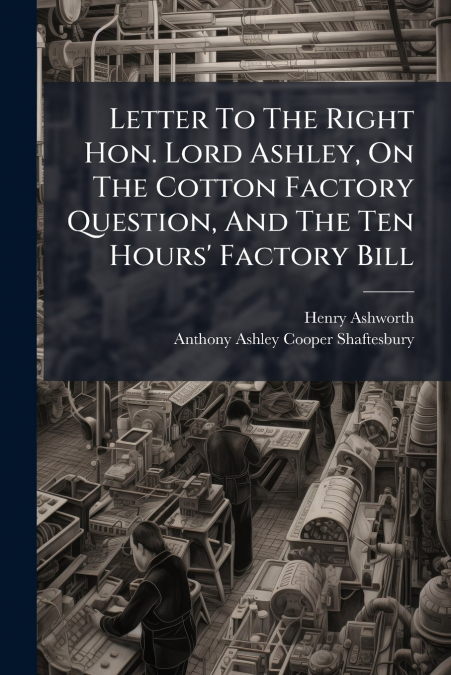
This is a letter written to Lord Ashley, a prominent advocate for social reform in 19th-century England, concerning the controversial 'Ten Hours’ Factory Bill'. Henry Ashworth discusses the implications of limiting the working hours in cotton factories to ten hours per day. The letter provides insights into the economic and social debates surrounding factory conditions and labor rights during the Industrial Revolution. It addresses concerns about the impact of reduced working hours on productivity, wages, and the overall competitiveness of the British cotton industry. The appendix contains an abstract of the bill. 'Letter To The Right Hon. Lord Ashley, On The Cotton Factory Question, And The Ten Hours’ Factory Bill' offers a valuable primary source for understanding the complex issues surrounding industrial labor and reform efforts in Victorian England. It sheds light on the perspectives of both factory owners and reformers, and provides a context for the social and political forces shaping labor legislation.This work has been selected by scholars as being culturally important, and is part of the knowledge base of civilization as we know it. This work was reproduced from the original artifact, and remains as true to the original work as possible. Therefore, you will see the original copyright references, library stamps (as most of these works have been housed in our most important libraries around the world), and other notations in the work.This work is in the public domain in the United States of America, and possibly other nations. Within the United States, you may freely copy and distribute this work, as no entity (individual or corporate) has a copyright on the body of the work.As a reproduction of a historical artifact, this work may contain missing or blurred pages, poor pictures, errant marks, etc. Scholars believe, and we concur, that this work is important enough to be preserved, reproduced, and made generally available to the public. We appreciate your support of the preservation process, and thank you for being an important part of keeping this knowledge alive and relevant.