 Librería Samer Atenea
 Kálamo Books
 Librería Elías (Asturias)
 Librería Kolima (Madrid)
 Librería Proteo (Málaga)
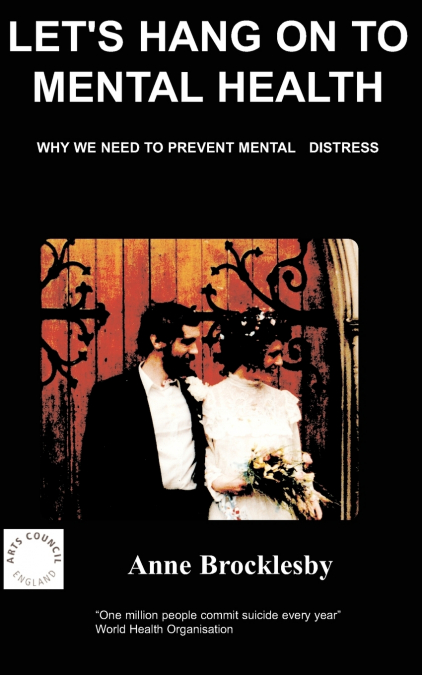
Let’s Hang on to Mental Health by Anne BrocklesbyISBN 13: 978 1 84747 015 7 Published: 2006Pages: 80Description This book is an attempt to help us all prevent the onset of mental distress. I have written it with the benefit of hindsight, because I have been through a ’nervous breakdown’ and been diagnosed with having Bipolar II Disorder, a form of manic depression. About the Author Anne Brocklesby was born in 1951 in Epsom, Surrey. She was educated in Wimbledon and Scotland before studying social sciences at Edinburgh University. She has now returned to live in Wimbledon where she has worked for many years in the voluntary sector. She is involved in the Make Poverty History campaign and takes an active interest in mental health issues, trying to promote a more positive image and challenging discrimination and stigma.Book Extract I’m sure that low-grade mental health problems affect most of us at some point in our lives. They say now don’t they that 1:4 people will experience mental health difficulty at some point in their life. I read a fairly old study by one of the government health departments that talked about the ’iceberg of depression’, referring to the hidden mental health problems out there. Either the individual does not know they have problems or they are too worried to consult a GP and a psychiatrist about them, or sometimes the medical profession completely misses the mental distress someone is in. Whatever the reason, there is a great deal of undiagnosed mental ill health, and we need to address this issue. How can we learn to recognise the warning signs? How can we be proactive instead of reactive, and encourage others to actually seek out help? What help is out there? For example, when I became acutely ill that awful weekend, my husband had to take charge and contact the services of the GP for me. I was in no state to do anything and in any case I was not really aware of all my problems at that stage - I was passed it. Are there good community services that we can rely on for help when we need it? I am talking about the serious end of mental distress too, when someone is feeling isolated and suicidal, and obviously needs urgent help and care. What sort of care exists for someone in this position? It is so easy to drift into suicidal feelings from depression. There has been a lot of publicity also about the effect of certain SSRI, modern anti-depressant medications like Seroxat, actually leading to suicide. I do feel that a great deal of mental health treatment is rather by luck than actual design for treating a condition. It seems too easy for a GP to prescribe an anti-depressant when a patient presents worries and anxieties. There has been a great increase in the number of prescriptions drafted by the GP as the first port of call. I wonder when is it deemed necessary for a patient to be referred on to the specialist psychiatrist when he/she presents, rather than to remain and be treated by the GP. I expect this depends to some extent on the services in the area, and the relationship between the GPs in practice with the consultant mental health team. I suppose I was lucky, in my case there is an active mental health trust and the procedure ensured that I was soon passed on to see the psychiatrist with my carer, my husband. I felt in good hands because I was being seen by a specialist. At that time of my breakdown, I did not have any kind of logical feelings at all, but I was definitely not suicidal. However, I was prescribed both an anti-psychotic and an anti-depressant. It was only years later after long-term treatment on anti-depressants that I began to feel as though it was all getting out of control and experiencing suicidal thoughts.