Alexandre Dumas / Auguste Maquet
 Librería Samer Atenea
 Kálamo Books
 Librería Elías (Asturias)
 Librería Kolima (Madrid)
 Librería Proteo (Málaga)
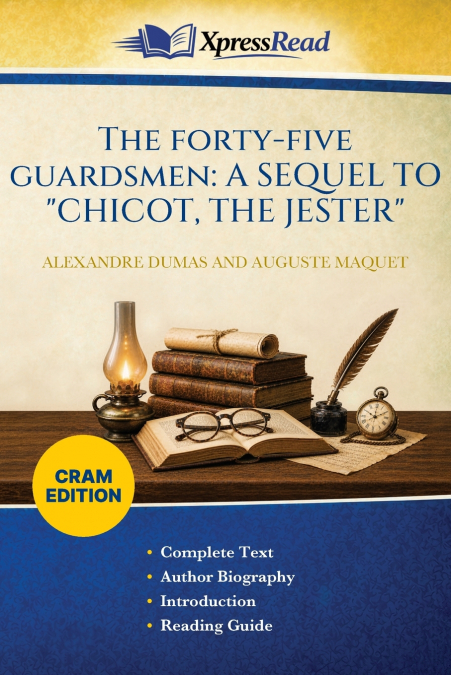
Les Quarante-Cinq, troisième et dernier volet de la trilogie romanesque d’Alexandre Dumas et Auguste Maquet consacrée au règne d’Henri III, replonge le lecteur dans les intrigues palpitantes de la cour de France. Après les événements décrits dans 'La Reine Margot' et 'La Dame de Monsoreau', ce roman publié en feuilleton en 1847-1848, met en scène une France déchirée par les conflits religieux et les ambitions politiques. Le lecteur retrouve Chicot, le fidèle bouffon du roi Henri, toujours prêt à déjouer les complots et à protéger son maître. L’intrigue s’épaissit avec l’arrivée de quarante-cinq gentilshommes gascons dévoués au duc d’Anjou, frère du roi, dont les manœuvres menacent la stabilité du royaume. Les passions s’exacerbent, les trahisons se multiplient, et le lecteur est entraîné dans un tourbillon d’aventures où l’amour, la vengeance et l’honneur s’entremêlent.This work has been selected by scholars as being culturally important, and is part of the knowledge base of civilization as we know it. This work was reproduced from the original artifact, and remains as true to the original work as possible. Therefore, you will see the original copyright references, library stamps (as most of these works have been housed in our most important libraries around the world), and other notations in the work.This work is in the public domain in the United States of America, and possibly other nations. Within the United States, you may freely copy and distribute this work, as no entity (individual or corporate) has a copyright on the body of the work.As a reproduction of a historical artifact, this work may contain missing or blurred pages, poor pictures, errant marks, etc. Scholars believe, and we concur, that this work is important enough to be preserved, reproduced, and made generally available to the public. We appreciate your support of the preservation process, and thank you for being an important part of keeping this knowledge alive and relevant.