Dr. Hari M. Koduvely / DrHari MKoduvely
 Librería Samer Atenea
 Kálamo Books
 Librería Elías (Asturias)
 Librería Kolima (Madrid)
 Librería Proteo (Málaga)
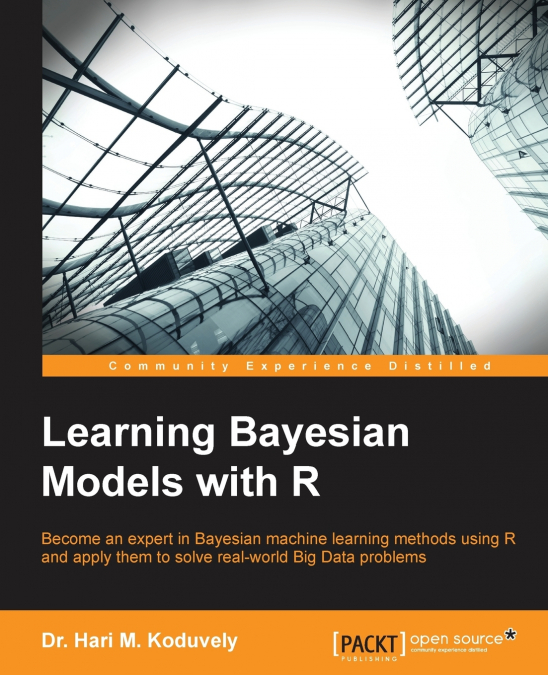
Become an expert in Bayesian Machine Learning methods using R and apply them to solve real-world big data problemsKey Features:Understand the principles of Bayesian Inference with less mathematical equationsLearn state-of-the art Machine Learning methodsFamiliarize yourself with the recent advances in Deep Learning and Big Data frameworks with this step-by-step guideBook Description:Bayesian Inference provides a unified framework to deal with all sorts of uncertainties when learning patterns form data using machine learning models and use it for predicting future observations. However, learning and implementing Bayesian models is not easy for data science practitioners due to the level of mathematical treatment involved. Also, applying Bayesian methods to real-world problems requires high computational resources. With the recent advances in computation and several open sources packages available in R, Bayesian modeling has become more feasible to use for practical applications today. Therefore, it would be advantageous for all data scientists and engineers to understand Bayesian methods and apply them in their projects to achieve better results.Learning Bayesian Models with R starts by giving you a comprehensive coverage of the Bayesian Machine Learning models and the R packages that implement them. It begins with an introduction to the fundamentals of probability theory and R programming for those who are new to the subject. Then the book covers some of the important machine learning methods, both supervised and unsupervised learning, implemented using Bayesian Inference and R.Every chapter begins with a theoretical description of the method explained in a very simple manner. Then, relevant R packages are discussed and some illustrations using data sets from the UCI Machine Learning repository are given. Each chapter ends with some simple exercises for you to get hands-on experience of the concepts and R packages discussed in the chapter.The last chapters are devoted to the latest development in the field, specifically Deep Learning, which uses a class of Neural Network models that are currently at the frontier of Artificial Intelligence. The book concludes with the application of Bayesian methods on Big Data using the Hadoop and Spark frameworks.What You Will Learn:Set up the R environmentCreate a classification model to predict and explore discrete variablesGet acquainted with Probability Theory to analyze random eventsBuild Linear Regression modelsUse Bayesian networks to infer the probability distribution of decision variables in a problemModel a problem using Bayesian Linear Regression approach with the R package BLRUse Bayesian Logistic Regression model to classify numerical dataPerform Bayesian Inference on massively large data sets using the MapReduce programs in R and Cloud computing