

 Librería Samer Atenea
 Kálamo Books
 Librería Elías (Asturias)
 Librería Kolima (Madrid)
 Librería Proteo (Málaga)
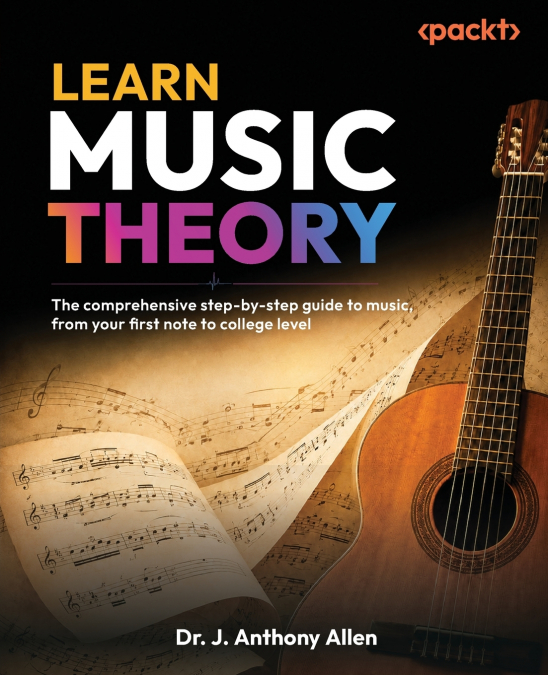
Understand how music works, from the notes on the page to the harmony behind them. Learn to read music, build chords and melodies, analyze compositions, and develop practical music theory skills with confidenceKey Features:- Build from notation and rhythm to advanced harmony, counterpoint, and modulation- Develop skills in scales, chords, SATB writing, songwriting, and composition- Connect theory to real music through step-by-step examples and analysisBook Description:Learn Music Theory takes you on a step-by-step journey from reading your first notes to understanding the ideas taught in a college-level music theory curriculum.You will begin with the building blocks of written music, learning how pitch, rhythm, notation, scales, keys, and chords work together. From there, the book gradually develops your understanding of melody and harmony, showing you how to recognize patterns, build chord progressions, and make sense of the music you read and hear. As your skills grow, you will explore how different musical lines work together, how harmony creates movement and resolution, and how composers develop richer musical ideas. Later chapters introduce more advanced techniques for writing, harmonizing, and analyzing music, including counterpoint, four-part writing, harmonic development, and changing keys. Throughout the book, practical examples and analysis of classical and popular music connect each new idea to real songs and music.By the end of this book, you will be able to read music more confidently, understand how melodies and harmonies are constructed, analyze musical passages, and apply a connected understanding of music theory from beginner fundamentals through college-level concepts.What You Will Learn:- Read traditional music notation- Understand how music works and why we like certain sounds over others- Songwriting, composition, and producing- Understand seventh chords, inversions, and harmonic function- Write melodies, chord progressions, and song structure- Create and harmonize a melody- Use cadences, sequences, tonicization, and modulation- Analyze harmony and form in classical and popular musicWho this book is for:This book is for aspiring and practicing musicians, songwriters, composers, producers, instrumentalists, students, and self-learners who want a structured understanding of music theory. It starts from the fundamentals, so no prior music theory experience is required. Readers who have struggled with theory before will find a gradual path from notation and rhythm to harmony, counterpoint, voice leading, and college-level analysis. It is also useful for learners preparing for formal music study or theory examinations.Table of Contents- Symbols of Music- Exploring Scales, Chords, and Keys- Minor Keys, The Circle of Fifths, and Compound Meters- Exploring Modes and Counterpoint- Advanced Counterpoint- 18th Century Counterpoint and SATB Composition- Harmonization- Harmonic Expansion- New Progressions and Key Changes- Diminished and Tonic Expansion- Melody, Phrasing and Motives- Modulation and Form- Six-Four Chords and Harmonic Expansion- Fugue and Invention- Chromatic Harmony- Chromatic Voice-Leading- Chromatic Modulation- The 20th Century- A New Language (Set Theory)- Serialism- The Now





