 Librería Samer Atenea
 Kálamo Books
 Librería Elías (Asturias)
 Librería Kolima (Madrid)
 Librería Proteo (Málaga)
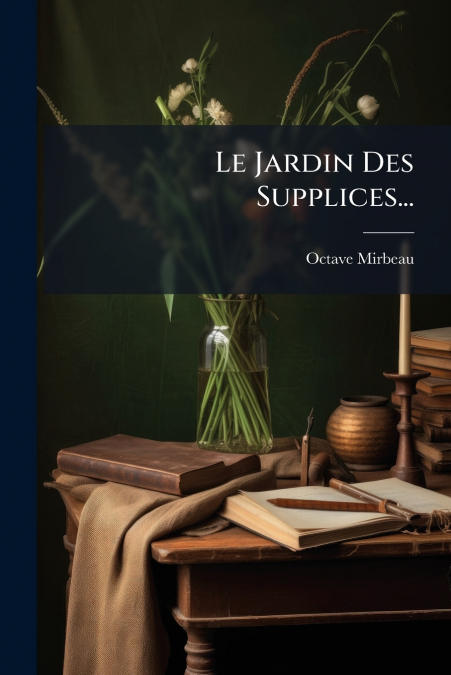
Le Jardin des supplices (The Garden of Tortures) is a novel by Octave Mirbeau, published in 1899, during the Dreyfus Affair. It is divided into three parts. The first part consists of reflections on the futility of existence, and the meaningless cruelty of mankind. The second part tells of the narrator’s love affair with Clara, an ambiguous, rich Englishwoman, intelligent and perverse, with whom he travels to China. The third part, which gives its title to the novel, describes a garden in which all kinds of tortures and executions are carried out. The novel can be read as a denunciation of the destructive instincts of humanity and of all forms of barbarity, whether individual or collective. It also explores the themes of eroticism and cruelty with a powerful lyrical force. 'Le Jardin des supplices' remains a disturbing and compelling work of French literature.This work has been selected by scholars as being culturally important, and is part of the knowledge base of civilization as we know it. This work was reproduced from the original artifact, and remains as true to the original work as possible. Therefore, you will see the original copyright references, library stamps (as most of these works have been housed in our most important libraries around the world), and other notations in the work.This work is in the public domain in the United States of America, and possibly other nations. Within the United States, you may freely copy and distribute this work, as no entity (individual or corporate) has a copyright on the body of the work.As a reproduction of a historical artifact, this work may contain missing or blurred pages, poor pictures, errant marks, etc. Scholars believe, and we concur, that this work is important enough to be preserved, reproduced, and made generally available to the public. We appreciate your support of the preservation process, and thank you for being an important part of keeping this knowledge alive and relevant.