

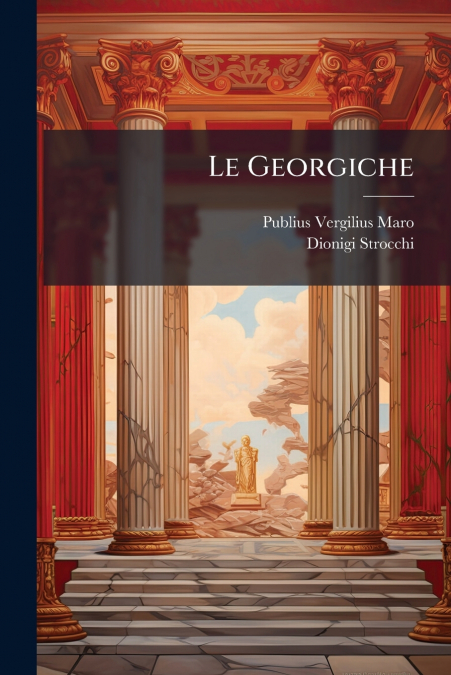
Dionigi Strocchi / Publius Vergilius Maro
 Librería Samer Atenea
 Kálamo Books
 Librería Elías (Asturias)
 Librería Kolima (Madrid)
 Librería Proteo (Málaga)
'Le Georgiche', written by Publius Vergilius Maro, also known as Virgil, is a didactic poem on agriculture. Drawing on a wealth of practical knowledge and deep understanding of the natural world, Virgil offers advice on crop cultivation, animal husbandry, beekeeping, and other aspects of rural life. Beyond its practical instructions, 'Le Georgiche' celebrates the beauty and order of nature, the dignity of labor, and the values of traditional Roman society. This edition, carefully curated by Dionigi Strocchi, presents Virgil’s timeless work to a new generation of readers, highlighting the poem’s enduring relevance and its influence on Western literature and culture. The themes of environmental stewardship and sustainable living resonate strongly with contemporary concerns, making 'Le Georgiche' a vital read for anyone interested in the intersection of nature, poetry, and history.This work has been selected by scholars as being culturally important, and is part of the knowledge base of civilization as we know it. This work was reproduced from the original artifact, and remains as true to the original work as possible. Therefore, you will see the original copyright references, library stamps (as most of these works have been housed in our most important libraries around the world), and other notations in the work.This work is in the public domain in the United States of America, and possibly other nations. Within the United States, you may freely copy and distribute this work, as no entity (individual or corporate) has a copyright on the body of the work.As a reproduction of a historical artifact, this work may contain missing or blurred pages, poor pictures, errant marks, etc. Scholars believe, and we concur, that this work is important enough to be preserved, reproduced, and made generally available to the public. We appreciate your support of the preservation process, and thank you for being an important part of keeping this knowledge alive and relevant.





