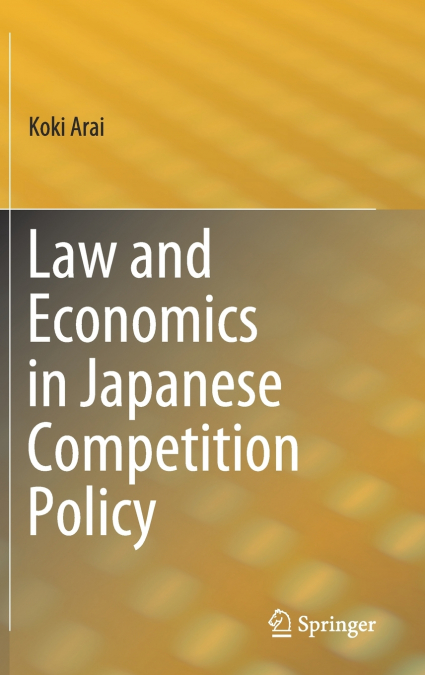
Law and Economics in Japanese Competition Policy

Law and Economics in Japanese Competition Policy

Koki Arai

160,61 €
IVA incluido
Disponible
Editorial:
Springer Nature B.V.
Año de edición:
2020
Materia
Gestión y técnicas de gestión
ISBN:
9789811381904
160,61 €
IVA incluido
Disponible

Selecciona una librería:

  • Librería Samer Atenea
  • Librería Aciertas (Toledo)
  • Kálamo Books
  • Librería Perelló (Valencia)
  • Librería Elías (Asturias)
  • Donde los libros
  • Librería Kolima (Madrid)
  • Librería Proteo (Málaga)

This book demonstrates how economics is used in cases of competition in Japan. Competition between firms is usually the most effective way of allocating economic resources and achieving consumer and producer welfare. At the same time, a balance must be struck; firms must not be over-regulated, but neither must they be completely free to create a monopoly or oligopoly. Therefore, the role of competition policy is to maintain a balance by using the collaborative economics of industrial organization. The book uses economic analysis to evaluate case studies on Japanese anti-monopoly law, the Act Concerning Prohibition of Private Monopolization and Maintenance of Fair Trade (AMA), and enforcement in e.g. cartel cases, private monopolization cases, and merger cases. The Japan Fair Trade Commission implements a competition policy, primarily through the enforcement of the AMA, which promotes ingenuity and innovation in business by guaranteeing and enhancing fair and free competition, thereby ensuring economic vitality and consumer benefit. This book is the first authoritative and compact work on competition policy in Japan, which has a more-than-70-year history and is based on solid legal principles. In addition, the book seeks to promote law enforcement based on economic analysis, and includes studies describing the enforcement mechanisms used. It provides comprehensive yet concise information on the structure of the AMA, recent cases, and economic analysis. It also explains the circumstances regarding recent cases and analyzes how the economic policy has been applied to actual cases. 

Artículos relacionados

  • Cases on Management and Organizational Behavior in an Arab Context
    Khoury
    In the era of globalization and ease of international connectivity and business interactions, professionals from all over the world benefit from having a well-rounded view of business culture and organizational practice at the regional level. Cases on Management and Organizational Behavior in an Arab Context provides a presentation of teaching cases emphasizing the positive and...
  • Climate Change, Supply Chain Management and Enterprise Adaptation
    Costas P. Pappis / Costas PPappis
    Mounting scientific evidence shows that Earth’s climate is dramatically changing due to the greenhouse emissions caused by human activities, notably by burning fossil fuels for energy production and transport. Climate Change, Supply Chain Management and Enterprise Adaptation: Implications of Global Warming on the Economy aims to provide one among many diverse responses to a gro...
  • # BUSINESS SAVVY PM tweet Book01
    Cinda Voegtli
    Does your job require you to manage projects? If yes, wouldn’t you like to be described as a project manager who is a successful, influential and respected leader of important efforts in the organization? Now if that already sounds like you, great! But if not, what you need to get there is known as ’business savvy.’Business savvy does not mean a bagful of academic credentials, ...
    Disponible

    22,55 €

  • Advanced Topics in Global Information Management Volume 2
    Felix Tan
    ...
  • Managing Business with SAP
    Linda Lau
    ...
  • Advances in Electronic Business, Volume I
    ...

Otros libros del autor

  • Law and Economics in Japanese Competition Policy
    Koki Arai
    This book demonstrates how economics is used in cases of competition in Japan. Competition between firms is usually the most effective way of allocating economic resources and achieving consumer and producer welfare. At the same time, a balance must be struck; firms must not be over-regulated, but neither must they be completely free to create a monopoly or oligopoly. Therefore...