 Librería Samer Atenea
 Kálamo Books
 Librería Elías (Asturias)
 Librería Kolima (Madrid)
 Librería Proteo (Málaga)
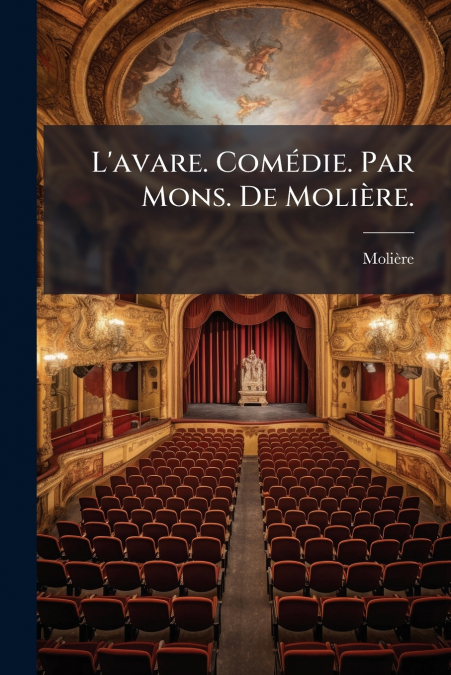
L’Avare (The Miser) is one of Molière’s most celebrated comedies. First performed in 1668, the play centers on Harpagon, a wealthy but pathologically miserly man who is so consumed by his love of money that he neglects the needs and desires of his children, Élise and Cléante. Harpagon’s relentless pursuit of wealth and his attempts to control his children’s lives lead to a series of farcical and dramatic situations. As Harpagon seeks to marry a young woman, Mariane, for her dowry, and plans to marry his daughter to an older, wealthy man to avoid paying a dowry, his children plot to outwit him and marry the people they truly love. The play satirizes the destructive nature of greed and the absurdity of prioritizing money over human relationships, solidifying Molière’s reputation as a master of social satire and comedic playwrighting. 'L’Avare' remains a timeless and insightful commentary on human nature and societal values.This work has been selected by scholars as being culturally important, and is part of the knowledge base of civilization as we know it. This work was reproduced from the original artifact, and remains as true to the original work as possible. Therefore, you will see the original copyright references, library stamps (as most of these works have been housed in our most important libraries around the world), and other notations in the work.This work is in the public domain in the United States of America, and possibly other nations. Within the United States, you may freely copy and distribute this work, as no entity (individual or corporate) has a copyright on the body of the work.As a reproduction of a historical artifact, this work may contain missing or blurred pages, poor pictures, errant marks, etc. Scholars believe, and we concur, that this work is important enough to be preserved, reproduced, and made generally available to the public. We appreciate your support of the preservation process, and thank you for being an important part of keeping this knowledge alive and relevant.