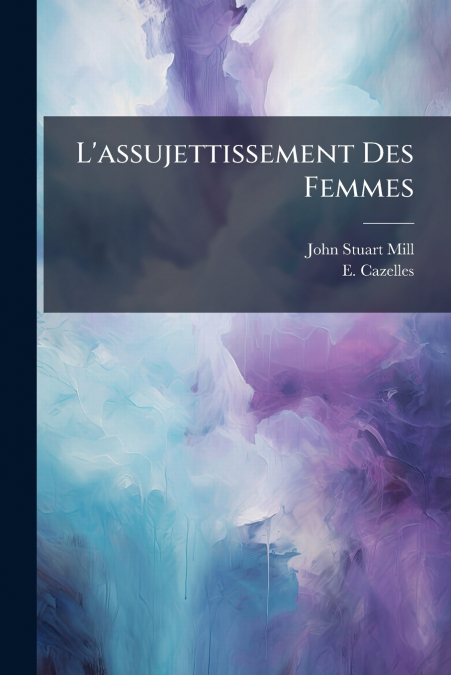
E. Cazelles / John Stuart Mill
 Librería Samer Atenea
 Kálamo Books
 Librería Elías (Asturias)
 Librería Kolima (Madrid)
 Librería Proteo (Málaga)
L’assujettissement des femmes, par John Stuart Mill, est un essai classique sur l’inégalité des sexes et la nécessité de l’émancipation des femmes. Traduit par E. Cazelles, cet ouvrage influent plaide en faveur de l’égalité des droits pour les femmes, arguant que leur assujettissement est un obstacle au progrès social et moral de l’humanité. Mill examine les arguments traditionnels utilisés pour justifier l’infériorité des femmes, les réfutant point par point avec une logique rigoureuse et une profonde conviction. Il explore les bénéfices qu’une société tirerait de la libération des femmes, tant sur le plan individuel que collectif. Ce texte fondateur du féminisme reste d’une actualité frappante, offrant une analyse pertinente des structures de pouvoir et des préjugés qui continuent de limiter les opportunités des femmes à travers le monde. L’assujettissement des femmes est une lecture essentielle pour quiconque s’intéresse à la justice sociale, à la philosophie politique et à l’histoire des idées.This work has been selected by scholars as being culturally important, and is part of the knowledge base of civilization as we know it. This work was reproduced from the original artifact, and remains as true to the original work as possible. Therefore, you will see the original copyright references, library stamps (as most of these works have been housed in our most important libraries around the world), and other notations in the work.This work is in the public domain in the United States of America, and possibly other nations. Within the United States, you may freely copy and distribute this work, as no entity (individual or corporate) has a copyright on the body of the work.As a reproduction of a historical artifact, this work may contain missing or blurred pages, poor pictures, errant marks, etc. Scholars believe, and we concur, that this work is important enough to be preserved, reproduced, and made generally available to the public. We appreciate your support of the preservation process, and thank you for being an important part of keeping this knowledge alive and relevant.