 Librería Samer Atenea
 Kálamo Books
 Librería Elías (Asturias)
 Librería Kolima (Madrid)
 Librería Proteo (Málaga)
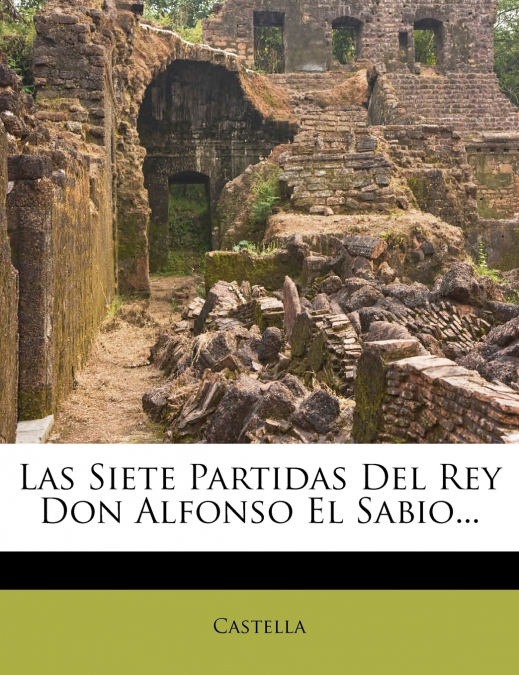
Las Siete Partidas del Rey Don Alfonso El Sabio is a cornerstone of Spanish legal history. This comprehensive legal code, commissioned by King Alfonso X 'the Wise' of Castile in the 13th century, aimed to establish a uniform body of law for the kingdom. Divided into seven parts, the work covers a vast range of topics, including canon law, civil law, criminal law, and procedural law. It also addresses social, political, and economic issues relevant to medieval Spain.This edition offers valuable insights into the legal and social structures of medieval Iberia, and remains a key source for understanding the development of Spanish law and its influence on legal systems in Latin America. The text provides a detailed picture of medieval life, reflecting the values, customs, and concerns of the time. For scholars of legal history, medieval studies, and Spanish history, 'Las Siete Partidas' is an indispensable resource.This work has been selected by scholars as being culturally important, and is part of the knowledge base of civilization as we know it. This work was reproduced from the original artifact, and remains as true to the original work as possible. Therefore, you will see the original copyright references, library stamps (as most of these works have been housed in our most important libraries around the world), and other notations in the work.This work is in the public domain in the United States of America, and possibly other nations. Within the United States, you may freely copy and distribute this work, as no entity (individual or corporate) has a copyright on the body of the work.As a reproduction of a historical artifact, this work may contain missing or blurred pages, poor pictures, errant marks, etc. Scholars believe, and we concur, that this work is important enough to be preserved, reproduced, and made generally available to the public. We appreciate your support of the preservation process, and thank you for being an important part of keeping this knowledge alive and relevant.