
Inicio > Derecho > Teoría general del derecho > La protection des marques à l’épreuve du numérique
La protection des marques à l’épreuve du numérique

La protection des marques à l’épreuve du numérique

Jean Yves MENDY

72,18 €
IVA incluido
Disponible
Editorial:
KS OmniScriptum Publishing
Año de edición:
2024
Materia
Teoría general del derecho
ISBN:
9786206727705
72,18 €
IVA incluido
Disponible

Selecciona una librería:

  • Librería Samer Atenea
  • Librería Aciertas (Toledo)
  • Kálamo Books
  • Librería Perelló (Valencia)
  • Librería Elías (Asturias)
  • Donde los libros
  • Librería Kolima (Madrid)
  • Librería Proteo (Málaga)

Une marque est un droit de propriété industrielle qui fait l’objet d’un enregistrement auprès d’un office national, régional ou mondial. En France, on dépose une marque auprès de l’INPI (Institut National de la Propriété Industrielle), en Europe auprès de l’EUIPO (office européen de la propriété intellectuelle). Pour une marque internationale, on passe par l’OMPI (Organisation Mondiale de la Propriété Intellectuelle). Au Sénégal, auprès de l’Organisation Africaine de la Propriété Intellectuelle (AOPI). Le droit de marque est obtenu grâce à l’enregistrement, qui fait suite à une procédure de dépôt au cours de laquelle l’office a procédé à un examen plus ou moins approfondi en fonction des pays, a éventuellement émis des objections, et a validé le caractère enregistrable de la marque. L’enregistrement n’est par ailleurs obtenu que si aucun tiers ne s’y est opposé pendant la période d’opposition. Être titulaire d’une marque enregistrée permet l’accès à différentes actions qui ne sont pas ouvertes aux personnes qui se contentent d’utiliser une marque sans l’avoir déposée : l’opposition devant l’AOPI, et l’action en contrefaçon devant le juge.
Artículos relacionados

  • EU General Data Protection Regulation (GDPR)
    IT Governance Privacy Team
    An in-depth guide to complying with the EU GDPR.Now in its second edition, EU GDPR – An Implementation and Compliance Guide is a clear and comprehensive guide to this new data protection law, providing a detailed commentary on the Regulation, and setting out the obligations of data  processors and controllers in clear and comprehensible terms.Read this book to learn: How the ...
    Disponible

    30,10 €

  • Banking Laws and Regulations in Nigeria
    Bello Mohammed Magaji
    Banking Law and Regulations in Nigeria: Selected Themes essentially deals with the laid down rules or code of conduct meant to control and set standards for banking business. Indeed, the main aim of the ongoing banking reforms in Nigeria, started in 2004, is to ensure banks’ conformity to the laid down banking rules and regulations. The eleven-chapter book contains vital and ri...
    Disponible

    41,17 €

  • States and the Interpretation of Treaties
    Dimitris Liakopoulos
    States and the Interpretation of Treaties opens with a provocative reconsideration of a debate on the subject of comparative international legal obligations by the United Nations’s International Law Commission. In this book, distinguished Tufts University legal scholar Dimitris Liakopoulos identifies and explores relevant considerations in the work of the Commission and offers ...
  • The role of customs in international treaties
    Dimitris Liakopoulos
    The Role of Customs in International Treaties concentrates on issues of friction between member states of the United Nations. In view of the role played by the United Nations in resolving international disputes, Dimitris Liakopoulos hypothesizes that 'practical guides' based on custom often catalyze the positions taken by states, courts, scholars, and other actors, constituting...
  • Debtor protection in American and European Union bankruptcy law
    Dimitris Liakopoulos
    In Debtor Protection in American and European Union Bankruptcy Law, international law scholar Dimitris Liakopulos raises a delicate issue at the foundations of the modern banking system by analyzing US bankruptcy law with a focus on the concept of automatic stay. His work identifies legal sources and authorities having repercussions in terms of operational protection. It then e...
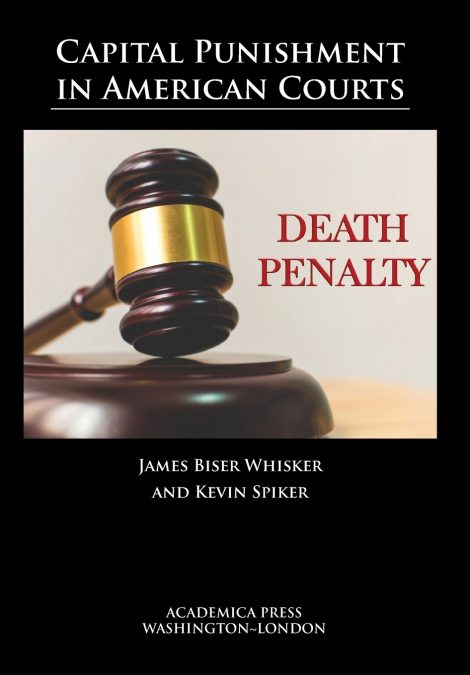
  • Capital punishment in American courts
    James Biser Whisker / Kevin Spiker
    In the 400 years since the first known execution was carried out for treason in Virginia, American jurisdictions have debated both the appropriateness and methods of capital punishment. Over that time, courts have placed varying restrictions on its application, excluding categories of citizens (for example the insane or the underaged) and evaluating and excluding methods of exe...