Inicio > Consulta, información y materias interdisciplinarias > Estudios interdisciplinarios > Estudios del desarrollo > La economía de la participación colectiva: desarrollo económico de la provincia de Chimborazo
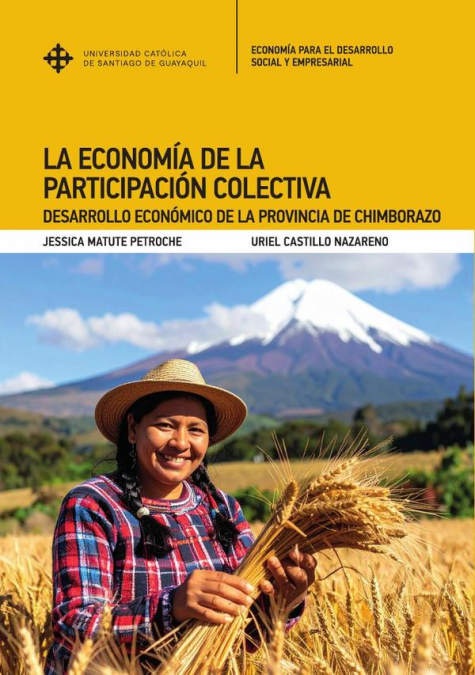
La economía de la participación colectiva: desarrollo económico de la provincia de Chimborazo

La economía de la participación colectiva: desarrollo económico de la provincia de Chimborazo

Jessica Matute Petroche / Uriel Castillo Nazareno

21,32 €
IVA incluido
Consulta disponibilidad
Editorial:
DIRECCIÓN DE PUBLICACIONES UNIVERSIDAD CATÓLICA SANTIAGO DE GUAYAQUIL
Año de edición:
2026
Materia
Estudios del desarrollo
ISBN:
9789942563170

Selecciona una librería:

  • Librería Samer Atenea
  • Librería Aciertas (Toledo)
  • Kálamo Books
  • Librería Perelló (Valencia)
  • Librería Elías (Asturias)
  • Donde los libros
  • Librería Kolima (Madrid)
  • Librería Proteo (Málaga)

La economía de la participación colectiva se aborda como un camino para el desarrollo de Chimborazo, Ecuador. Inicia con un análisis socioproductivo de la provincia, enfatizando su significado histórico y geográfico. Propone que el desarrollo territorial se construye a partir del sentido de vida que los habitantes otorgan a su espacio, validado por una masa crítica. A lo largo del texto, se exponen los retos inherentes a este enfoque y se sienta una base teórica para la participación común. Finalmente, el documento culmina con la presentación de un plan de acción concreto, buscando traducir los conceptos teóricos en estrategias aplicables para fomentar un desarrollo arraigado en la identidad y movilización local. Se destaca la originalidad del enfoque al proponer la Economía de la Participación Común como motor de desarrollo, vinculándola directamente con la historia y cultura de Chimborazo; la estructura que va desde el análisis conceptual hasta el plan de acción es coherente y práctica. El valor de la obra reside en proponer una solución endógena y participativa para el desarrollo territorial.

Artículos relacionados

  • Mobile Information Communication Technologies Adoption in Developing Countries
    The mobile technology field is expanding with innovative research and discoveries that expand to all walks of life. Mobile technology may have its greatest impact in the developing world, because it brings telecommunication to districts that had never been reached before. Mobile Information Communication Technologies Adoption in Developing Countries: Effects and Implications re...
  • Impact of Disruptive Technologies on the Socio-Economic Development of Emerging Countries
    Global emergencies, such as the COVID-19 pandemic and environmental concerns, have challenged the readiness of societies and forced them to operate in more innovative ways. In response, the world has witnessed new technologies emerge and researchers continually finding better solutions to cope with these situations. It is crucial that these innovations are investigated so that ...
    Disponible

    222,57 €

  • The Drivers and Outcomes of Global Health Diplomacy
    Maria Berta Ecija
    This book investigates the Brazilian health cooperation in Mozambique through the implementation of a pharmaceutical factory in Maputo. ...
  • Gulf Ideological Dynamics
    GEW Reports & Analyses Team. / Hichem Karoui (Editor)
    The Gulf ideological system is a set of interconnected beliefs and principles governing the region’s political, economic, social, and cultural spheres. It combines various ideologies, including religious, nationalist, tribal, and pan-Islamic ideologies. It is shaped by a combination of historical, cultural, and socio-economic factors. Political alliances, economic shifts, socia...
    Disponible

    32,90 €

  • The Rise of Africa’s Middle Class
    Henning Melber
    Across Africa, a burgeoning middle class has become the poster child for the 'Africa rising' narrative. Ambitious, aspirational and increasingly affluent, this group is said to embody the values and hopes of the new Africa, with international bodies ranging from the United Nations Development Programme to the World Bank regarding them as important agents of both economi...
  • AIDS in Africa- How Did It Ever Happen
    Frank Ham
    This book offers a unique personal perspective on the HIV/AIDS crisis in Africa. It is a first person narrative of a European homosexual who tested positive in the early eighties. The author owes his survival to tell the tale not least to the drugs, which in his home country are accessible to any person who is HIV positive. Frank Ham visited Malawi in 1999 and repeatedly therea...
    Disponible

    36,43 €