 Librería Samer Atenea
 Kálamo Books
 Librería Elías (Asturias)
 Librería Kolima (Madrid)
 Librería Proteo (Málaga)
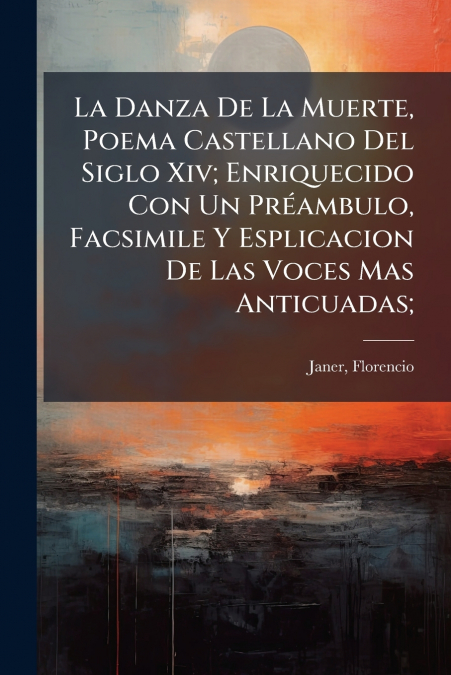
La Danza de la Muerte, Poema Castellano del Siglo XIV is a meticulously presented edition of the medieval Spanish poem 'Dance of Death,' enriched by Florencio Janer. Published in 1856, this volume offers not only the original text but also a comprehensive preamble, a facsimile of the manuscript, and explanations of the archaic vocabulary. Janer’s work provides invaluable context for understanding the poem within its historical and linguistic setting. The inclusion of a facsimile allows readers to engage directly with the visual representation of the original document, offering a tangible connection to the past. The detailed explanations of the ancient words make the text accessible to modern readers, ensuring that the poem’s themes of mortality and the ephemeral nature of life resonate across the centuries. This edition is a significant contribution to the study of medieval Spanish literature and offers a unique insight into the cultural and artistic landscape of the 14th century.This work has been selected by scholars as being culturally important, and is part of the knowledge base of civilization as we know it. This work was reproduced from the original artifact, and remains as true to the original work as possible. Therefore, you will see the original copyright references, library stamps (as most of these works have been housed in our most important libraries around the world), and other notations in the work.This work is in the public domain in the United States of America, and possibly other nations. Within the United States, you may freely copy and distribute this work, as no entity (individual or corporate) has a copyright on the body of the work.As a reproduction of a historical artifact, this work may contain missing or blurred pages, poor pictures, errant marks, etc. Scholars believe, and we concur, that this work is important enough to be preserved, reproduced, and made generally available to the public. We appreciate your support of the preservation process, and thank you for being an important part of keeping this knowledge alive and relevant.