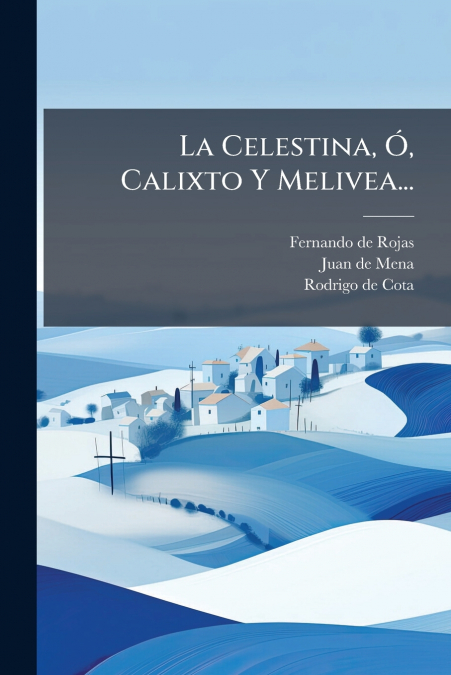
Fernando de Rojas / Juan de Mena / Rodrigo de Cota
 Librería Samer Atenea
 Kálamo Books
 Librería Elías (Asturias)
 Librería Kolima (Madrid)
 Librería Proteo (Málaga)
La Celestina, also known as Tragicomedia de Calixto y Melibea, is a foundational work of Spanish literature. Attributed to Fernando de Rojas, with possible contributions from Juan de Mena and Rodrigo de Cota, this influential text bridges the gap between medieval and Renaissance literary sensibilities.The narrative centers on the ill-fated love affair between Calixto and Melibea, facilitated by the cunning and manipulative procuress, Celestina. Through vivid dialogue and complex characterizations, the work explores themes of love, desire, greed, and the consequences of unchecked passions. La Celestina’s enduring appeal lies in its realistic portrayal of human nature and its innovative dramatic structure, marking a significant departure from earlier literary forms. Its impact on subsequent Spanish literature is undeniable, solidifying its place as a cornerstone of the literary canon.This work has been selected by scholars as being culturally important, and is part of the knowledge base of civilization as we know it. This work was reproduced from the original artifact, and remains as true to the original work as possible. Therefore, you will see the original copyright references, library stamps (as most of these works have been housed in our most important libraries around the world), and other notations in the work.This work is in the public domain in the United States of America, and possibly other nations. Within the United States, you may freely copy and distribute this work, as no entity (individual or corporate) has a copyright on the body of the work.As a reproduction of a historical artifact, this work may contain missing or blurred pages, poor pictures, errant marks, etc. Scholars believe, and we concur, that this work is important enough to be preserved, reproduced, and made generally available to the public. We appreciate your support of the preservation process, and thank you for being an important part of keeping this knowledge alive and relevant.