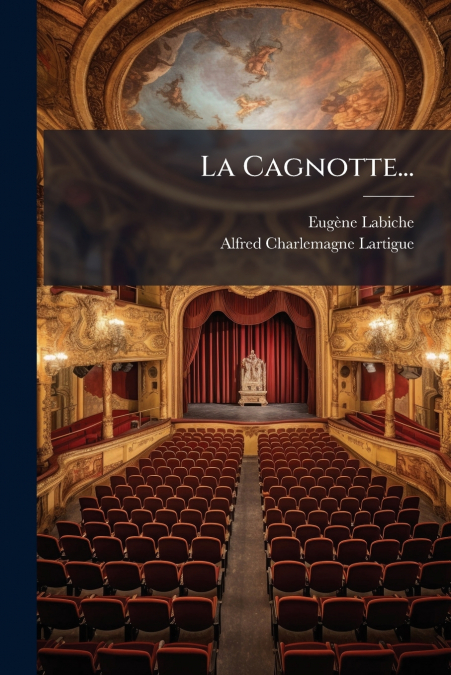
Eugène Labiche / Alfred Charlemagne Lartigue
 Librería Samer Atenea
 Kálamo Books
 Librería Elías (Asturias)
 Librería Kolima (Madrid)
 Librería Proteo (Málaga)
La Cagnotte is a classic French comedy by Eugène Labiche, one of the most prolific and popular playwrights of the 19th century. Written in collaboration with Alfred Charlemagne Lartigue, this play showcases Labiche’s talent for creating farcical situations and humorous characters. The play revolves around a group of provincial friends who decide to pool their money (’la cagnotte’) for a trip to Paris. Their journey is filled with mishaps, misunderstandings, and uproarious adventures, highlighting the foibles and eccentricities of the French bourgeoisie. Labiche’s sharp wit and keen observation of social customs make ’La Cagnotte’ a delightful and enduring example of French comedic theater. This edition allows modern readers to rediscover the charm and humor of Labiche’s work, offering insight into the social dynamics and comedic sensibilities of 19th-century France.This work has been selected by scholars as being culturally important, and is part of the knowledge base of civilization as we know it. This work was reproduced from the original artifact, and remains as true to the original work as possible. Therefore, you will see the original copyright references, library stamps (as most of these works have been housed in our most important libraries around the world), and other notations in the work.This work is in the public domain in the United States of America, and possibly other nations. Within the United States, you may freely copy and distribute this work, as no entity (individual or corporate) has a copyright on the body of the work.As a reproduction of a historical artifact, this work may contain missing or blurred pages, poor pictures, errant marks, etc. Scholars believe, and we concur, that this work is important enough to be preserved, reproduced, and made generally available to the public. We appreciate your support of the preservation process, and thank you for being an important part of keeping this knowledge alive and relevant.