
Inicio > Sociedad y ciencias sociales > Psicología > Kshurika Upanishad Yogaraja Upanishad Mahavakya Upanishad
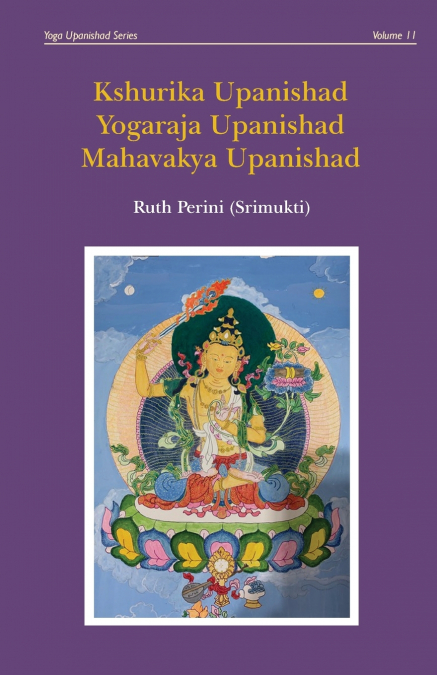
Kshurika Upanishad Yogaraja Upanishad Mahavakya Upanishad

Kshurika Upanishad Yogaraja Upanishad Mahavakya Upanishad

Ruth B Perini

8,41 €
IVA incluido
Disponible
Editorial:
Independent Publishing
Año de edición:
2026
Materia
Psicología
ISBN:
9780648910794
8,41 €
IVA incluido
Disponible

Selecciona una librería:

  • Librería Samer Atenea

  • Kálamo Books
  • Librería Elías (Asturias)
  • Librería Kolima (Madrid)
  • Librería Proteo (Málaga)

The book contains three short Upanishads: Kṣurika, Yogarāja and Mahāvākya.Kṣurika means ’razor’ which is likened to the yogic practices which cut through the aspirant’s attachments and ignorance. The Upaniṣad starts with an invocation, in which the aspirant seeking spiritual revelation prays for peace, energy and understanding for all who are inquiring into its meaning and message. They need the help of the Divine as it is difficult to remove worldly attachments.To achieve the goal of freedom from attachments, perfect concentration is needed. The practice of nāḍī śodhana, alternate nostril breathing, must be practised to destroy the impurities in the nāḍīs.There are detailed instruction on breath control, prāṇāyama, to move the prāṇa, energy, up suṣumnā nāḍī to the heart, then the throat, then the eyebrow centre and finally the crown of the head. On the way, the life-force in the marmans, vulnerable areas of the body, can be freed by the practice of prāṇāyama. No longer trapped in the web of desires and attachment, the yogin attains true liberation.Yogarāja means ’royal yoga’, as it is the most effective path for attainment in yoga.The Upaniṣad has twenty-one verses, which begin by declaring that the four yogas of mantra, laya, haṭha and rāja must be understood and practised for perfection in yoga. They all include the stages of āsana, prāṇāyama, dhyāna and samādhi.The next five to eighteen verses describe the nine chakras: brahma, svādhiṣṭhāna, nābhi, hṛdaya, viśuddhi, tālukā, ghaṇṭa, bhrū, brahmarandhra, and vyoma. The Upaniṣad concludes that the sage who meditates on each of the nine chakras, through practice and supreme grace, gradually attains liberation.The Mahāvākya Upaniṣad is connected with the Atharvaveda, and consists of twelve verses. In the first two verses Lord Brahman emphasises that it should only be taught to those who wish to know the inner true Self and are not entangled in worldly life. The aspirant must withdraw from knowledge through the senses. Vision through the sense organs conceals the all-pervading Brahman from that which, to the ignorant, appears permanent and indestructible, such as a mountain, the earth and even the whole universe. The ātman is the inner sun in the heart. It is the pure consciousness, without desires, self-illuminating with its own fire. Whoever continually repeats the mantra so’ham becomes paramātmā, existence-thought-bliss. This is the unique message of advaita-vedānta: tat tvam asi (that thou art), one of the Mahāvākyas, Great Statements.


Artículos relacionados

  • Drinkers of Infinity
    Arthur Koestler
    This selection of essays, book-reviews, broadcast talks and papers delivered to learned societies reflects the extraordinary breadth of Arthur Koestler’s interests. From the trial of Galileo to the pleasures of canoeing down the Loire, from a detailed examination of the ‘memory’ of flatworms to an equally detailed examination of the futility of quarantining dogs, the author wri...
    Disponible

    17,24 €

  • Gordy the Rabbit has ADHD
    Jessie Shepherd
    Often when people are given a mental health disorder diagnosis the weaknesses are clear and overwhelmingly emphasized, while the strengths are ignored or forgotten. The mental health children's book series 'What Mental Disorder?' challenges the stigma against therapy and diagnosis. It enlists the reader to view the character as a whole being and not as a mental issu...
    Disponible

    16,30 €

  • The Paradoxical Ego
    Eugene Halliday / Zhu Kabere
    Three particular themes are basic to this study. First, that the human race and its environment are involved in a slowly progressive process of revelation and understanding of its inherent features; and that we are all participating in this ongoing evolutionary cycle. Second, and closely related to the first tenet, man is not separable from his environment. We all share in this...
    Disponible

    14,56 €

  • On Being Human and When a Man Comes to Himself
    Woodrow Wilson
    Before he became the 28th President of the United States (1913-21), the 34th Governor of New Jersey (1911-13), or even the 13th President of Princeton University (1902-10), Woodrow Wilson (1856-1924) was a scholar and professor. In 1885, he received his Ph.D. in history and political science from Johns Hopkins University, and in 1897, he was granted tenure at Princeton Universi...
    Disponible

    8,89 €

  • Bridge Over The River Why
    David Cooper / Deborah Cooper
    'In Bridge Over the River Why, the Coopers have succeeded in a dual task documenting their own journey through the grief of losing their son Eli by suicide, while at the same time providing a valuable resource for anyone who has had to face the same terrible tragedy. They start with the premise that 'doing and feeling' are the key components of moving forward and have a core me...
  • Extraordinary Leadership
    Cher Holton
    This transformational leadership book, grounded in state-of-the-art research and proven by real-life application in the trenches, moves beyond traditional leadership theories to introduce you to seven incredible Core Abilities and shows you how to connect with them to become an Extraordinary Leader who can bring out the very best in your people.All the techniques in the world w...
    Disponible

    23,85 €