 Librería Samer Atenea
 Librería Aciertas (Toledo)
 Kálamo Books
 Librería Perelló (Valencia)
 Librería Elías (Asturias)
 Donde los libros
 Librería Kolima (Madrid)
 Librería Proteo (Málaga)
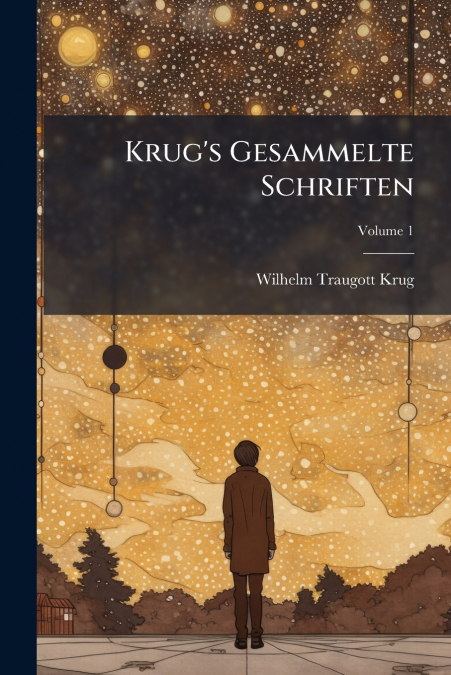
Krug’s Gesammelte Schriften, Volume 1 presents a collection of writings by the influential German philosopher Wilhelm Traugott Krug. This volume offers a comprehensive look into Krug’s philosophical perspectives, exploring themes and ideas that shaped 19th-century German thought. Krug, known for his contributions to transcendental philosophy and his role as Immanuel Kant’s successor at the University of Königsberg, provides insightful essays that reflect his engagement with metaphysics, epistemology, and ethics. These collected writings showcase Krug’s critical analysis and his attempts to synthesize various philosophical traditions. Readers interested in the history of philosophy, particularly the development of post-Kantian thought, will find this volume an invaluable resource. The essays provide a window into the intellectual debates of the era and highlight Krug’s lasting impact on the philosophical landscape.This work has been selected by scholars as being culturally important, and is part of the knowledge base of civilization as we know it. This work was reproduced from the original artifact, and remains as true to the original work as possible. Therefore, you will see the original copyright references, library stamps (as most of these works have been housed in our most important libraries around the world), and other notations in the work.This work is in the public domain in the United States of America, and possibly other nations. Within the United States, you may freely copy and distribute this work, as no entity (individual or corporate) has a copyright on the body of the work.As a reproduction of a historical artifact, this work may contain missing or blurred pages, poor pictures, errant marks, etc. Scholars believe, and we concur, that this work is important enough to be preserved, reproduced, and made generally available to the public. We appreciate your support of the preservation process, and thank you for being an important part of keeping this knowledge alive and relevant.