

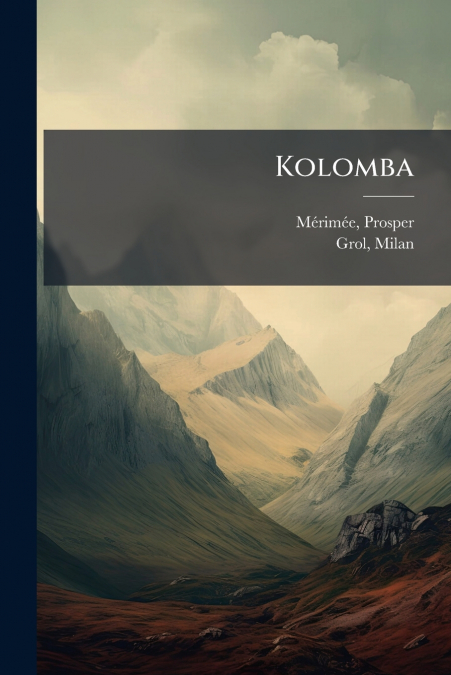
Grol Milan 1876- / Mérimée Prosper 1803-1870
 Librería Samer Atenea
 Kálamo Books
 Librería Elías (Asturias)
 Librería Kolima (Madrid)
 Librería Proteo (Málaga)
'Kolomba' is a compelling novella by Prosper Mérimée, originally published in 1840. Set against the backdrop of 19th-century Corsica, the story explores themes of family honor, revenge, and cultural identity. The narrative follows Kolomba, a strong-willed Corsican woman, as she seeks justice for her father’s murder. When her brother, Antoine, returns to the island as a lieutenant in the French army, Kolomba urges him to avenge their father’s death, despite Antoine’s initial reluctance and the complexities of Corsican vendettas. Mérimée’s vivid descriptions of the Corsican landscape and culture, combined with his insightful portrayal of complex characters, make 'Kolomba' a timeless exploration of human nature and societal conflict. Milan Grol’s involvement suggests a possible translation or adaptation, making this edition a valuable addition to any collection of classic literature.This work has been selected by scholars as being culturally important, and is part of the knowledge base of civilization as we know it. This work was reproduced from the original artifact, and remains as true to the original work as possible. Therefore, you will see the original copyright references, library stamps (as most of these works have been housed in our most important libraries around the world), and other notations in the work.This work is in the public domain in the United States of America, and possibly other nations. Within the United States, you may freely copy and distribute this work, as no entity (individual or corporate) has a copyright on the body of the work.As a reproduction of a historical artifact, this work may contain missing or blurred pages, poor pictures, errant marks, etc. Scholars believe, and we concur, that this work is important enough to be preserved, reproduced, and made generally available to the public. We appreciate your support of the preservation process, and thank you for being an important part of keeping this knowledge alive and relevant.





